Ch.15 - Chemical Equilibrium
Brown - Chemistry: The Central Science 14th Edition
Brown14th EditionChemistry: The Central ScienceISBN: 9780134414232당신이 사용하는 게 아니라요?교과서 변경
15장, 문제 29

Mercury(I) oxide decomposes into elemental mercury and elemental oxygen: 2 Hg2O(s) ⇌ 4 Hg(l) + O2(g). (a) Write the equilibrium-constant expression for this reaction in terms of partial pressures. (b) Suppose you run this reaction in a solvent that dissolves elemental mercury and elemental oxygen. Rewrite the equilibrium-constant expression in terms of molarities for the reaction, using (solv) to indicate solvation.

검증된 단계별 안내
1
Step 1: Identify the reaction and the phases of each component. The given reaction is 2 Hg2O(s) ⇌ 4 Hg(l) + O2(g). Note that Hg2O is a solid, Hg is a liquid, and O2 is a gas.
Step 2: Write the equilibrium-constant expression in terms of partial pressures for the gaseous components. Since solids and liquids do not appear in the equilibrium expression, only the gaseous component O2 will be included. The expression is K_p = P_{O2}, where P_{O2} is the partial pressure of O2.
Step 3: Consider the scenario where the reaction occurs in a solvent that dissolves elemental mercury and elemental oxygen. In this case, we need to express the equilibrium constant in terms of molarities.
Step 4: Rewrite the balanced chemical equation considering the solvation: 2 Hg2O(s) ⇌ 4 Hg(solv) + O2(solv). Here, (solv) indicates that the species are dissolved in the solvent.
Step 5: Write the equilibrium-constant expression in terms of molarities for the dissolved species. The expression is K_c = [O2(solv)], where [O2(solv)] is the molarity of dissolved oxygen.

주요 개념

질문에 올바르게 답하기 위해 반드시 이해해야 하는 핵심 개념들은 다음과 같습니다.

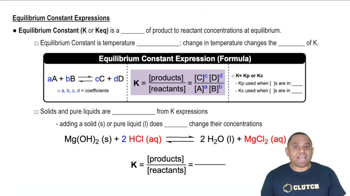
Equilibrium Constant Expression

The equilibrium constant expression (K) quantifies the ratio of the concentrations or partial pressures of products to reactants at equilibrium. For gaseous reactions, it is expressed in terms of partial pressures, while for reactions in solution, it is expressed in terms of molarities. The general form is K = [products]^[coefficients] / [reactants]^[coefficients], where square brackets denote concentration or pressure.
추천 영상:
가이드 코스
03:20
Equilibrium Constant Expressions

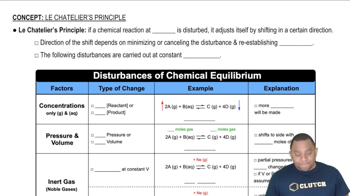
Le Chatelier's Principle

Le Chatelier's Principle states that if a dynamic equilibrium is disturbed by changing the conditions, the system will adjust to counteract the change and restore a new equilibrium. This principle is crucial for understanding how changes in concentration, pressure, or temperature affect the position of equilibrium in a chemical reaction.
추천 영상:
가이드 코스
07:32
Le Chatelier's Principle

Solvation and Molarity

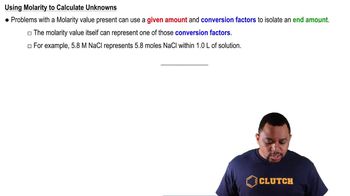
Solvation refers to the process of surrounding solute particles with solvent molecules, which can affect the concentration of solutes in a solution. Molarity (M) is a measure of concentration defined as moles of solute per liter of solution. In the context of the given reaction, when elemental mercury and oxygen are dissolved, their concentrations must be expressed in molarity, indicating their effective participation in the equilibrium.
추천 영상: