At 1000 K, 𝐾𝑝 = 1.85 for the reaction SO2(𝑔) + 12 O2(𝑔) ⇌ SO3(𝑔) (c) What is the value of 𝐾𝑐 for the reaction in part (b)?
Ch.15 - Chemical Equilibrium
15장, 문제 26b
Consider the following equilibrium, for which Kp = 0.0752 at 480°C: 2 Cl2(g) + 2 H2O(g) ⇌ 4 HCl(g) + O2(g) (b) What is the value of Kp for the reaction Cl2(g) + H2O(g) ⇌ 2 HCl(g) + 1/2 O2(g)?
검증된 단계별 안내1
Understand that the equilibrium constant Kp is dependent on the stoichiometry of the balanced chemical equation. The given reaction is: 2 Cl2(g) + 2 H2O(g) ⇌ 4 HCl(g) + O2(g) with Kp = 0.0752.
Recognize that the new reaction Cl2(g) + H2O(g) ⇌ 2 HCl(g) + 1/2 O2(g) is derived by halving the coefficients of the original reaction. This means the stoichiometry of the reaction has changed.
Recall that when the coefficients of a balanced equation are multiplied by a factor, the equilibrium constant is raised to the power of that factor. In this case, the coefficients are halved, which corresponds to raising Kp to the power of 1/2.
Express the mathematical relationship for the new Kp: Kp(new) = (Kp(original))^(1/2).
Substitute the given Kp value into the equation: Kp(new) = (0.0752)^(1/2). This will give you the equilibrium constant for the new reaction.

비슷한 문제에 대한 검증된 영상 답변:
이 영상 해법은 위 문제에 도움이 된다고 튜터들이 추천한 것입니다.
영상 길이:
3m주요 개념
질문에 올바르게 답하기 위해 반드시 이해해야 하는 핵심 개념들은 다음과 같습니다.
Equilibrium Constant (Kp)
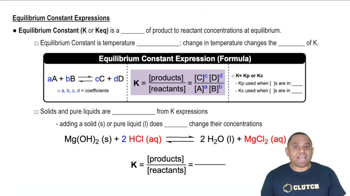
The equilibrium constant, Kp, is a numerical value that expresses the ratio of the concentrations of products to reactants at equilibrium for a given reaction at a specific temperature. It is calculated using the partial pressures of gases involved in the reaction. A Kp value less than 1 indicates that reactants are favored at equilibrium, while a value greater than 1 suggests that products are favored.
추천 영상:
가이드 코스
Equilibrium Constant Expressions
Reaction Stoichiometry
Reaction stoichiometry refers to the quantitative relationship between the amounts of reactants and products in a chemical reaction, as represented by the balanced chemical equation. In this case, the stoichiometry of the reactions must be carefully considered to relate the Kp values of different but related reactions, as they can be derived from one another by manipulating the coefficients of the balanced equations.
추천 영상:
가이드 코스
Stoichiometry Concept
Manipulating Equilibrium Expressions
When dealing with equilibrium constants, it is essential to understand how to manipulate equilibrium expressions. If a reaction is reversed, the new Kp is the reciprocal of the original. If the coefficients of a balanced equation are multiplied by a factor, the Kp is raised to the power of that factor. This principle allows for the calculation of Kp for related reactions based on known values.
추천 영상:
가이드 코스
Equilibrium Constant Expressions
관련 실천
교과서 질문
1089
views
교과서 질문
Consider the equilibrium N2(𝑔) + O2(𝑔) + Br2(𝑔) ⇌ 2 NOBr(𝑔) Calculate the equilibrium constant 𝐾𝑝 for this reaction, given the following information at 298 K:
2 NO(𝑔) + Br2(𝑔) ⇌ 2 NOBr(𝑔) 𝐾𝑐 = 2.02
NO(𝑔) ⇌ N2(𝑔) + O2(𝑔) 𝐾𝑐 = 2.1×1030
990
views
교과서 질문
Consider the following equilibrium, for which 𝐾𝑝 = 0.0752 at 480°C: 2 Cl2(𝑔) + 2 H2O(𝑔) ⇌ 4 HCl(𝑔) + O2(𝑔) (a) What is the value of 𝐾𝑝 for the reaction 4 HCl(𝑔) + O2(𝑔) ⇌ 2 Cl2(𝑔) + 2 H2O(𝑔)?
1048
views
교과서 질문
The following equilibria were attained at 823 K:
CoO(s) + H2(g) → Co(s) + H2O(g) Kc = 67
CoO(s) + CO(g) → Co(s) + CO2(g) Kc = 490
Based on these equilibria, calculate the equilibrium constant for H2(g) + CO2(g) → CO(g) + H2O(g) at 823 K.
127
views