
Ch.15 - Chemical Equilibrium
Brown - Chemistry: The Central Science 14th Edition
Brown14th EditionChemistry: The Central ScienceISBN: 9780134414232당신이 사용하는 게 아니라요?교과서 변경
15장, 문제 8a

The reaction A2 + B2 ⇌ 2 AB has an equilibrium constant Kc = 1.5. The following diagrams represent reaction mixtures containing A2 molecules (red), B2 molecules (blue), and AB molecules. (a) Which reaction mixture is at equilibrium?

검증된 단계별 안내
1
Step 1: Understand the concept of equilibrium. In a chemical reaction, equilibrium is the state where the concentrations of all reactants and products remain constant over time. The equilibrium constant (Kc) is a measure of the ratio of the concentrations of products to reactants at equilibrium.
Step 2: Identify the balanced chemical equation for the reaction. In this case, it is A2 + B2 ⇌ 2 AB. This tells us that for every one molecule of A2 and B2 that reacts, two molecules of AB are produced.
Step 3: Understand the equilibrium constant expression for this reaction. It is given by Kc = [AB]^2 / ([A2][B2]). This expression tells us that at equilibrium, the square of the concentration of AB divided by the product of the concentrations of A2 and B2 is equal to Kc.
Step 4: Look at the diagrams provided. The reaction mixture that is at equilibrium will have concentrations of A2, B2, and AB such that when substituted into the equilibrium constant expression, the result is equal to the given Kc value of 1.5.
Step 5: Compare the number of molecules (which is proportional to concentration) of A2, B2, and AB in each diagram to the balanced chemical equation and the equilibrium constant expression. The diagram that satisfies the equilibrium constant expression with Kc = 1.5 is the one at equilibrium.

비슷한 문제에 대한 검증된 영상 답변:

이 영상 해법은 위 문제에 도움이 된다고 튜터들이 추천한 것입니다.
영상 길이:
4m

주요 개념

질문에 올바르게 답하기 위해 반드시 이해해야 하는 핵심 개념들은 다음과 같습니다.

Chemical Equilibrium

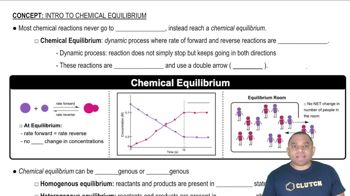
Chemical equilibrium occurs when the rates of the forward and reverse reactions are equal, resulting in constant concentrations of reactants and products. In the context of the given reaction, A2 and B2 combine to form AB, and at equilibrium, the concentrations of A2, B2, and AB remain unchanged over time.
추천 영상:
가이드 코스
04:21
Chemical Equilibrium Concepts

Equilibrium Constant (Kc)

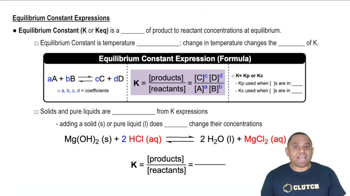
The equilibrium constant, Kc, quantifies the ratio of the concentrations of products to reactants at equilibrium for a given reaction at a specific temperature. For the reaction A2 + B2 ⇌ 2 AB, Kc = [AB]^2 / ([A2][B2]). A Kc value of 1.5 indicates that at equilibrium, the concentration of AB is greater than that of A2 and B2, suggesting a tendency towards product formation.
추천 영상:
가이드 코스
03:20
Equilibrium Constant Expressions

Le Chatelier's Principle

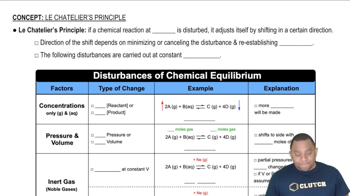
Le Chatelier's Principle states that if a system at equilibrium is disturbed by changes in concentration, temperature, or pressure, the system will adjust to counteract the disturbance and restore a new equilibrium. This principle helps predict how the equilibrium position will shift in response to changes in the concentrations of A2, B2, or AB in the reaction mixture.
추천 영상:
가이드 코스
07:32
Le Chatelier's Principle
관련 실천
교과서 질문

When lead(IV) oxide is heated above 300°C, it decomposes according to the reaction, 2 PbO2(𝑠) ⇌ 2PbO(𝑠) + O2(𝑔). Consider the two sealed vessels of PbO2 shown here. If both vessels are heated to 400°C and allowed to come to equilibrium, which of the following statements is or are true? a. There will be less PbO2 remaining in vessel A,

314
views
교과서 질문

When lead(IV) oxide is heated above 300°C, it decomposes according to the reaction, 2 PbO2(𝑠)⇌2PbO(𝑠)+O2(𝑔). Consider the two sealed vessels of PbO2 shown here. If both vessels are heated to 400°C and allowed to come to equilibrium, which of the following statements is or are true?

b. There will be less PbO2 remaining in vessel B,

714
views
교과서 질문

The diagram shown here represents the equilibrium state for the reaction A2(𝑔) + 2B(𝑔) ⇌ 2AB(𝑔). (a) Assuming the volume is 2 L, calculate the equilibrium constant 𝐾𝑐 for the reaction.

663
views
교과서 질문

When lead(IV) oxide is heated above 300°C, it decomposes according to the reaction, 2 PbO2(𝑠) ⇌ 2PbO(𝑠) + O2(𝑔). Consider the two sealed vessels of PbO2 shown here. If both vessels are heated to 400°C and allowed to come to equilibrium, which of the following statements is or are true? (c) The amount of PbO2 remaining in each vessel will be the same. [Find more in Section 15.4]

305
views
교과서 질문

Suppose that the gas-phase reactions A → B and B → A are both elementary reactions with rate constants of 4.7×10⁻³ s−1 and 5.8×10⁻¹ s−1, respectively. (a) What is the value of the equilibrium constant for the equilibrium A(g) ⇌ B(g)? (b) Which is greater at equilibrium, the partial pressure of A or the partial pressure of B?

469
views