
Ch.15 - Chemical Equilibrium
Brown - Chemistry: The Central Science 14th Edition
Brown14th EditionChemistry: The Central ScienceISBN: 9780134414232당신이 사용하는 게 아니라요?교과서 변경
15장, 문제 85

When 1.50 mol CO2 and 1.50 mol H2 are placed in a 3.00-L container at 395 _x001F_C, the following reaction occurs: CO2(g) + H2(g) ⇌ CO(g) + H2O(g). If Kc = 0.802, what are the concentrations of each substance in the equilibrium mixture?

검증된 단계별 안내
1
Step 1: Write the balanced chemical equation for the reaction: CO_2(g) + H_2(g) ⇌ CO(g) + H_2O(g).
Step 2: Set up an ICE (Initial, Change, Equilibrium) table to track the concentrations of each species. Initially, [CO_2] = [H_2] = 1.50 mol / 3.00 L, and [CO] = [H_2O] = 0 mol/L.
Step 3: Define the change in concentration for the reactants and products in terms of x, where x is the amount of CO_2 and H_2 that react. The changes are: [CO_2] = [H_2] = -x, [CO] = [H_2O] = +x.
Step 4: Express the equilibrium concentrations in terms of x: [CO_2] = [H_2] = (1.50/3.00) - x, [CO] = [H_2O] = x.
Step 5: Substitute the equilibrium concentrations into the expression for the equilibrium constant K_c = ([CO][H_2O])/([CO_2][H_2]) and solve for x using K_c = 0.802.

주요 개념

질문에 올바르게 답하기 위해 반드시 이해해야 하는 핵심 개념들은 다음과 같습니다.

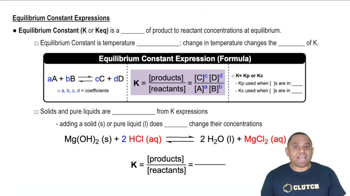
Equilibrium Constant (Kc)

The equilibrium constant (Kc) is a numerical value that expresses the ratio of the concentrations of products to reactants at equilibrium for a given reaction at a specific temperature. For the reaction CO2(g) + H2(g) ⇌ CO(g) + H2O(g), Kc = [CO][H2O] / [CO2][H2]. A Kc value greater than 1 indicates that products are favored at equilibrium, while a value less than 1 suggests that reactants are favored.
추천 영상:
가이드 코스
03:20
Equilibrium Constant Expressions

Concentration Calculations

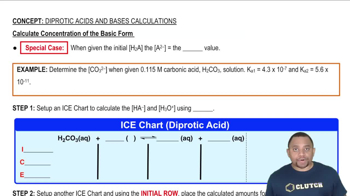
Concentration is defined as the amount of a substance per unit volume of solution, typically expressed in moles per liter (M). To find the equilibrium concentrations of each substance, one must first determine the initial concentrations by dividing the number of moles by the volume of the container. Changes in concentration due to the reaction must then be accounted for using an ICE (Initial, Change, Equilibrium) table.
추천 영상:
가이드 코스
07:35
Calculate Concentration of the Basic Form

Le Chatelier's Principle

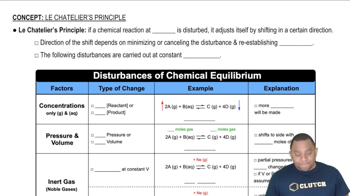
Le Chatelier's Principle states that if a dynamic equilibrium is disturbed by changing the conditions, the system will adjust to counteract the change and restore a new equilibrium. In the context of the given reaction, if the concentration of reactants or products is altered, the system will shift in the direction that reduces the effect of that change, which is crucial for predicting how concentrations will adjust at equilibrium.
추천 영상:
가이드 코스
07:32
Le Chatelier's Principle
관련 실천
교과서 질문

A 0.831-g sample of SO3 is placed in a 1.00-L container and heated to 1100 K. The SO3 decomposes to SO2 and O2: 2SO3(𝑔) ⇌ 2 SO2(𝑔) + O2(𝑔) At equilibrium, the total pressure in the container is 1.300 atm. Find the values of 𝐾𝑝 and 𝐾𝑐 for this reaction at 1100 K.

1351
views
교과서 질문

Nitric oxide (NO) reacts readily with chlorine gas as follows: 2 NO(𝑔) + Cl2(𝑔) ⇌ 2 NOCl(𝑔) At 700 K, the equilibrium constant Kp for this reaction is 0.26. Predict the behavior of each of the following mixtures at this temperature and indicate whether or not the mixtures are at equilibrium. If not, state whether the mixture will need to produce more products or reactants to reach equilibrium.

(a) PNO = 0.15 atm, PCl2 = 0.31 atm, PNOCl = 0.11 atm

(b) PNO = 0.12 atm, PCl2 = 0.10 atm, PNOCl = 0.050 atm

(c) PNO = 0.15 atm, PCl2 = 0.20 atm, PNOCl = 5.10 × 10⁻³ atm

835
views
교과서 질문

The equilibrium constant constant 𝐾𝑐 for C(𝑠) + CO2(𝑔) ⇌ 2 CO(𝑔) is 1.9 at 1000 K and 0.133 at 298 K. (a) If excess C is allowed to react with 25.0 g of CO2 in a 3.00-L vessel at 1000 K, how many grams of CO are produced? (b) If excess C is allowed to react with 25.0 g of CO2 in a 3.00-L vessel at 1000 K, how many grams of C are consumed?

954
views
교과서 질문

At 900 °C, 𝐾𝑐 = 0.0108 for the reaction

CaCO3(𝑠) ⇌ CaO(𝑠) + CO2(𝑔)

A mixture of CaCO3, CaO, and CO2 is placed in a 10.0-L vessel at 900°C. For the following mixtures, will the amount of CaCO3 increase, decrease, or remain the same as the system approaches equilibrium?

(a) 15.0 g CaCO3, 15.0 g CaO, and 4.25 g CO2

(b) 2.50 g CaCO3, 25.0 g CaO, and 5.66 g CO2

(c) 30.5 g CaCO3, 25.5 g CaO, and 6.48 g CO2

724
views
1
rank