
교과서 질문
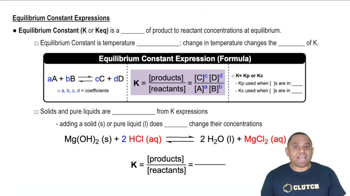
At 700 K, the equilibrium constant for the reaction CCl4(𝑔) ⇌ C(𝑠) + 2 Cl2(𝑔) is 𝐾𝑝 = 0.76. A flask is charged with 2.00 atm of CCl4, which then reaches equilibrium at 700 K. (a) What fraction of the CCl4 is converted into C and Cl2?

 검증된 단계별 안내
 03:20
03:20
 01:16
01:16 01:15
01:15At 700 K, the equilibrium constant for the reaction CCl4(𝑔) ⇌ C(𝑠) + 2 Cl2(𝑔) is 𝐾𝑝 = 0.76. A flask is charged with 2.00 atm of CCl4, which then reaches equilibrium at 700 K. (a) What fraction of the CCl4 is converted into C and Cl2?
Nitric oxide (NO) reacts readily with chlorine gas as follows: 2 NO(𝑔) + Cl2(𝑔) ⇌ 2 NOCl(𝑔) At 700 K, the equilibrium constant Kp for this reaction is 0.26. Predict the behavior of each of the following mixtures at this temperature and indicate whether or not the mixtures are at equilibrium. If not, state whether the mixture will need to produce more products or reactants to reach equilibrium.
(a) PNO = 0.15 atm, PCl2 = 0.31 atm, PNOCl = 0.11 atm
(b) PNO = 0.12 atm, PCl2 = 0.10 atm, PNOCl = 0.050 atm
(c) PNO = 0.15 atm, PCl2 = 0.20 atm, PNOCl = 5.10 × 10⁻³ atm
At 900 °C, 𝐾𝑐 = 0.0108 for the reaction
CaCO3(𝑠) ⇌ CaO(𝑠) + CO2(𝑔)
A mixture of CaCO3, CaO, and CO2 is placed in a 10.0-L vessel at 900°C. For the following mixtures, will the amount of CaCO3 increase, decrease, or remain the same as the system approaches equilibrium?
(a) 15.0 g CaCO3, 15.0 g CaO, and 4.25 g CO2
(b) 2.50 g CaCO3, 25.0 g CaO, and 5.66 g CO2
(c) 30.5 g CaCO3, 25.5 g CaO, and 6.48 g CO2