Ch.15 - Chemical Equilibrium
Brown - Chemistry: The Central Science 14th Edition
Brown14th EditionChemistry: The Central ScienceISBN: 9780134414232당신이 사용하는 게 아니라요?교과서 변경
15장, 문제 19

Which of the following statements are true and which are false? (a) The equilibrium constant can never be a negative number. (b) In reactions that we draw with a single-headed arrow, the equilibrium constant has a value that is very close to zero.

검증된 단계별 안내
1
Step 1: Understand the concept of the equilibrium constant (K). It is a ratio of the concentrations of products to reactants, each raised to the power of their stoichiometric coefficients, at equilibrium. The equilibrium constant is always a positive number because concentrations cannot be negative.
Step 2: Analyze statement (a): 'The equilibrium constant can never be a negative number.' Since concentrations are always positive, the equilibrium constant, which is a ratio of these concentrations, must also be positive. Therefore, statement (a) is true.
Step 3: Consider the meaning of a single-headed arrow in chemical reactions. A single-headed arrow indicates a reaction that goes to completion, meaning the reactants are fully converted to products, and the reverse reaction is negligible.
Step 4: Analyze statement (b): 'In reactions that we draw with a single-headed arrow, the equilibrium constant has a value that is very close to zero.' For reactions that go to completion, the equilibrium constant is actually very large, not close to zero, because the concentration of products is much higher than that of reactants at equilibrium.
Step 5: Conclude that statement (b) is false because a large equilibrium constant indicates a reaction that favors the formation of products, not a value close to zero.

주요 개념

질문에 올바르게 답하기 위해 반드시 이해해야 하는 핵심 개념들은 다음과 같습니다.

Equilibrium Constant

The equilibrium constant (K) is a numerical value that expresses the ratio of the concentrations of products to reactants at equilibrium for a reversible chemical reaction. It is always a positive value because it is derived from concentrations, which cannot be negative. A K value greater than 1 indicates that products are favored, while a value less than 1 indicates that reactants are favored.
추천 영상:
가이드 코스
01:14
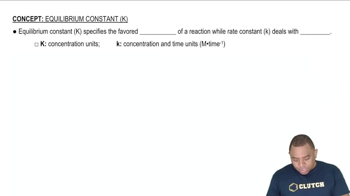
Equilibrium Constant K

Single-Headed Arrow in Reactions

A single-headed arrow in a chemical equation indicates a one-way reaction, meaning that the reactants convert to products without reverting back. In such cases, the reaction does not reach equilibrium, and thus the concept of an equilibrium constant does not apply. Therefore, the value of K for these reactions is not defined in the same way as for reversible reactions.
추천 영상:
가이드 코스
01:11
Single Displacement Reactions

Equilibrium vs. Non-Equilibrium Reactions

Equilibrium reactions are characterized by the ability to reach a state where the rates of the forward and reverse reactions are equal, allowing for the calculation of an equilibrium constant. In contrast, non-equilibrium reactions, indicated by a single-headed arrow, do not reach this state, and thus the concept of an equilibrium constant is irrelevant. Understanding this distinction is crucial for interpreting the behavior of chemical reactions.
추천 영상:
가이드 코스
02:35
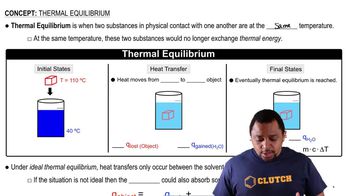
Thermal Equilibrium