
Ch.17 - Additional Aspects of Aqueous Equilibria
Brown - Chemistry: The Central Science 14th Edition
Brown14th EditionChemistry: The Central ScienceISBN: 9780134414232당신이 사용하는 게 아니라요?교과서 변경
17장, 문제 3

A buffer contains a weak acid, HA, and its conjugate base. The weak acid has a pKa of 4.5, and the buffer has a pH of 4.3. Without doing a calculation, state which of these possibilities are correct at pH 4.3. (a) 3HA4 = 3A-4, (b) 3HA4 7 3A-4, or (c) 3HA4 6 3A-4. [Section 17.2]

검증된 단계별 안내
1
Understand the relationship between pH, pKa, and the concentrations of the weak acid and its conjugate base using the Henderson-Hasselbalch equation: \( \text{pH} = \text{pKa} + \log \left( \frac{[A^-]}{[HA]} \right) \).
Since the pH (4.3) is less than the pKa (4.5), the logarithmic term \( \log \left( \frac{[A^-]}{[HA]} \right) \) must be negative.
A negative logarithm indicates that the ratio \( \frac{[A^-]}{[HA]} \) is less than 1, meaning \([A^-] < [HA]\).
This implies that the concentration of the weak acid, HA, is greater than the concentration of its conjugate base, A^-.
Therefore, the correct possibility is (b) \([HA] > [A^-]\).

비슷한 문제에 대한 검증된 영상 답변:

이 영상 해법은 위 문제에 도움이 된다고 튜터들이 추천한 것입니다.
도움이 되었나요?

주요 개념

질문에 올바르게 답하기 위해 반드시 이해해야 하는 핵심 개념들은 다음과 같습니다.

Buffer Solutions

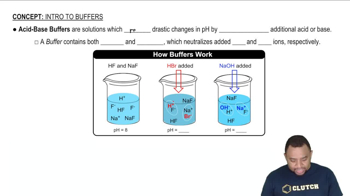
A buffer solution is a system that resists changes in pH upon the addition of small amounts of acid or base. It typically consists of a weak acid and its conjugate base, which work together to neutralize added acids or bases. Understanding how buffers maintain pH is crucial for analyzing the behavior of the weak acid HA and its conjugate base in the given scenario.
추천 영상:
가이드 코스
03:02
Buffer Solutions

Henderson-Hasselbalch Equation

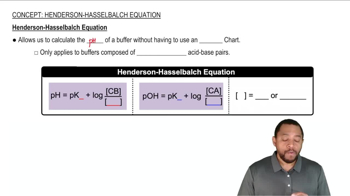
The Henderson-Hasselbalch equation relates the pH of a buffer solution to the pKa of the weak acid and the ratio of the concentrations of the conjugate base to the weak acid. It is expressed as pH = pKa + log([A-]/[HA]). This equation helps predict the relative amounts of HA and A- in the buffer at a given pH, which is essential for determining the correct relationship among the concentrations in the question.
추천 영상:
가이드 코스
02:40
Henderson-Hasselbalch Equation

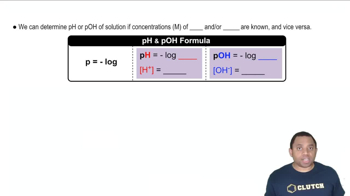
pKa and pH Relationship

The pKa of a weak acid is the pH at which the concentrations of the acid (HA) and its conjugate base (A-) are equal. When the pH is lower than the pKa, the solution contains more HA than A-. Conversely, if the pH is higher than the pKa, the solution has more A-. In this case, since the pH (4.3) is below the pKa (4.5), we can infer that the concentration of HA is greater than that of A-, which is key to answering the question.
추천 영상:
가이드 코스
02:09
pH and pOH Calculations
관련 실천
교과서 질문

The following diagram represents a buffer composed of equal concentrations of a weak acid, HA, and its conjugate base, A-. The heights of the columns are proportional to the concentrations of the components of the buffer. (c) Which of the three represents a situation that cannot arise from the addition of either an acid or a base? [Section 17.2]

694
views
교과서 질문

The following figure represents solutions at various stages of the titration of a weak acid, HA, with NaOH. (The Na+ ions and water molecules have been omitted for clarity.) To which of the following regions of the titration curve does each drawing correspond: (b) after addition of NaOH but before the equivalence point? [Section 17.3]

1274
views
교과서 질문

The beaker on the right contains 0.1 M acetic acid solution with methyl orange as an indicator. The beaker on the left contains a mixture of 0.1 M acetic acid and 0.1 M sodium acetate with methyl orange. (a) Using Figures 16.8 and 16.9, which solution has a higher pH?

747
views
교과서 질문

The following diagram represents a buffer composed of equal concentrations of a weak acid, HA, and its conjugate base, A-. The heights of the columns are proportional to the concentrations of the components of the buffer. (a) Which of the three drawings, (1), (2), or (3), represents the buffer after the addition of a strong acid? [Section 17.2]

377
views
교과서 질문

The beaker on the right contains 0.1 M acetic acid solution with methyl orange as an indicator. The beaker on the left contains a mixture of 0.1 M acetic acid and 0.1 M sodium acetate with methyl orange. (b) Which solution is better able to maintain its pH when small amounts of NaOH are added? Explain. [Sections 17.1 and 17.2]

642
views