
Ch.17 - Additional Aspects of Aqueous Equilibria
Brown - Chemistry: The Central Science 14th Edition
Brown14th EditionChemistry: The Central ScienceISBN: 9780134414232당신이 사용하는 게 아니라요?교과서 변경
17장, 문제 2b

The beaker on the right contains 0.1 M acetic acid solution with methyl orange as an indicator. The beaker on the left contains a mixture of 0.1 M acetic acid and 0.1 M sodium acetate with methyl orange. (b) Which solution is better able to maintain its pH when small amounts of NaOH are added? Explain. [Sections 17.1 and 17.2]
Beaker (i) with blue acetic acid solution, beaker (ii) with yellow acetic acid and sodium acetate mixture.

검증된 단계별 안내
1
Identify the components of each solution: Beaker (i) contains 0.1 M acetic acid with methyl orange, and Beaker (ii) contains a mixture of 0.1 M acetic acid and 0.1 M sodium acetate with methyl orange.
Understand the role of each component: Acetic acid (CH3COOH) is a weak acid, and sodium acetate (CH3COONa) is its conjugate base. Methyl orange is an indicator that changes color based on pH.
Recognize the concept of a buffer solution: A buffer solution resists changes in pH when small amounts of acid or base are added. Beaker (ii) contains both acetic acid and its conjugate base, forming a buffer solution.
Compare the ability to maintain pH: When NaOH (a strong base) is added, the buffer solution in Beaker (ii) will neutralize the added base by converting acetic acid to acetate, thus maintaining the pH. Beaker (i) lacks the conjugate base and will experience a more significant pH change.
Conclude which solution is better at maintaining pH: Beaker (ii) with the acetic acid and sodium acetate mixture is better able to maintain its pH when small amounts of NaOH are added due to its buffer capacity.

비슷한 문제에 대한 검증된 영상 답변:

이 영상 해법은 위 문제에 도움이 된다고 튜터들이 추천한 것입니다.
영상 길이:
8m

주요 개념

질문에 올바르게 답하기 위해 반드시 이해해야 하는 핵심 개념들은 다음과 같습니다.

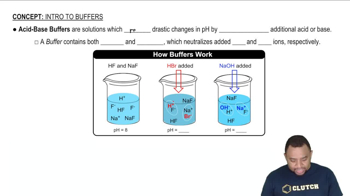
Buffer Solutions

A buffer solution is a mixture of a weak acid and its conjugate base that resists changes in pH when small amounts of acid or base are added. In this case, the beaker on the left contains acetic acid and sodium acetate, which together form a buffer system. This allows the solution to maintain a relatively stable pH compared to the beaker with only acetic acid.
추천 영상:
가이드 코스
03:02
Buffer Solutions

Acetic Acid and Sodium Acetate

Acetic acid (CH₃COOH) is a weak acid that partially dissociates in solution, while sodium acetate (CH₃COONa) is its conjugate base. When NaOH is added to the buffer solution, the acetate ions can react with the hydroxide ions to form more acetic acid, thus minimizing the change in pH. This reaction is crucial for the buffer's ability to maintain pH stability.
추천 영상:
가이드 코스
02:15
Acids and Their Structure

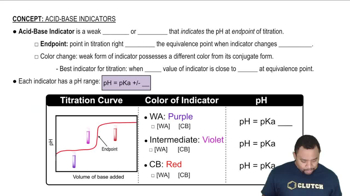
pH and Indicators

pH is a measure of the acidity or basicity of a solution, with lower values indicating higher acidity. Methyl orange is a pH indicator that changes color depending on the pH of the solution. In the context of the beakers, the color change observed in the solutions indicates their pH levels, which helps in understanding how well each solution can resist pH changes when NaOH is added.
추천 영상:
가이드 코스
04:30
Acid-Base Indicators