
Ch.17 - Additional Aspects of Aqueous Equilibria
Brown - Chemistry: The Central Science 14th Edition
Brown14th EditionChemistry: The Central ScienceISBN: 9780134414232당신이 사용하는 게 아니라요?교과서 변경
17장, 문제 24

A buffer is prepared by adding 10.0 g of ammonium chloride (NH4Cl) to 250 mL of 1.00 M NH3 solution. (b) Write the complete ionic equation for the reaction that occurs when a few drops of nitric acid are added to the buffer. (c) Write the complete ionic equation for the reaction that occurs when a few drops of potassium hydroxide solution are added to the buffer.

검증된 단계별 안내
1
Step 1: Identify the components of the buffer solution. The buffer is composed of NH3 (ammonia) and NH4Cl (ammonium chloride). NH3 is a weak base, and NH4+ (from NH4Cl) is its conjugate acid.
Step 2: Consider the addition of nitric acid (HNO3) to the buffer. HNO3 is a strong acid and will react with the base component of the buffer, NH3. Write the chemical equation for this reaction: NH3 + HNO3 -> NH4+ + NO3-.
Step 3: Convert the chemical equation to the complete ionic equation. Since HNO3 is a strong acid, it dissociates completely in water: NH3 + H+ + NO3- -> NH4+ + NO3-. The NO3- ions are spectator ions and do not participate in the reaction.
Step 4: Consider the addition of potassium hydroxide (KOH) to the buffer. KOH is a strong base and will react with the acid component of the buffer, NH4+. Write the chemical equation for this reaction: NH4+ + OH- -> NH3 + H2O.
Step 5: Convert the chemical equation to the complete ionic equation. Since KOH is a strong base, it dissociates completely in water: K+ + OH- + NH4+ -> NH3 + H2O. The K+ ions are spectator ions and do not participate in the reaction.

주요 개념

질문에 올바르게 답하기 위해 반드시 이해해야 하는 핵심 개념들은 다음과 같습니다.

Buffer Solutions

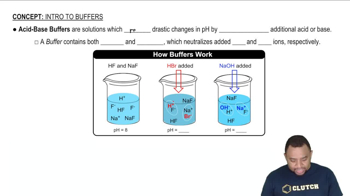
A buffer solution is a system that resists changes in pH upon the addition of small amounts of acid or base. It typically consists of a weak acid and its conjugate base or a weak base and its conjugate acid. In this case, the buffer is made from ammonia (NH3) and ammonium chloride (NH4Cl), which helps maintain a stable pH when acids or bases are introduced.
추천 영상:
가이드 코스
03:02
Buffer Solutions

Ionic Equations

Ionic equations represent the species that are actually involved in a chemical reaction, showing the ions in their dissociated form. In the context of the buffer, when nitric acid (HNO3) or potassium hydroxide (KOH) is added, the complete ionic equations will illustrate how these strong acids and bases interact with the buffer components, highlighting the formation of products and the ions present.
추천 영상:
가이드 코스
00:51
Net Ionic Equations

Acid-Base Reactions

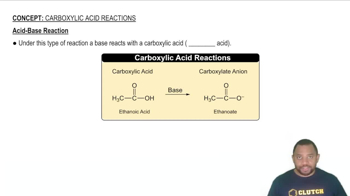
Acid-base reactions involve the transfer of protons (H+) between reactants. In the case of the buffer, adding nitric acid introduces H+ ions, which react with the ammonia (NH3) to form ammonium ions (NH4+). Conversely, adding potassium hydroxide provides OH- ions, which react with NH4+ to regenerate NH3 and water, demonstrating the buffer's ability to neutralize added acids and bases.
추천 영상:
가이드 코스
01:09
Acid-Base Reaction