
Ch.17 - Additional Aspects of Aqueous Equilibria
Brown - Chemistry: The Central Science 14th Edition
Brown14th EditionChemistry: The Central ScienceISBN: 9780134414232당신이 사용하는 게 아니라요?교과서 변경
17장, 문제 81b

(b) What is the most significant difference between the sulfides precipitated in group 2 and those precipitated in group 3?
Flowchart illustrating selective precipitation of metal cations in groups 1 to 5.

검증된 단계별 안내
1
Identify the sulfides precipitated in Group 2: CuS, CdS, Bi2S3, PbS, HgS, As2S3, Sb2S3, SnS2.
Identify the sulfides precipitated in Group 3: ZnS, NiS, MnS, CoS.
Note that Group 2 sulfides are precipitated in acidic conditions (H2S and 0.2 M HCl).
Note that Group 3 sulfides are precipitated in basic conditions (NH4)2S at pH = 8.0.
The most significant difference is the pH condition under which the sulfides precipitate: Group 2 sulfides precipitate in acidic conditions, while Group 3 sulfides precipitate in basic conditions.

비슷한 문제에 대한 검증된 영상 답변:

이 영상 해법은 위 문제에 도움이 된다고 튜터들이 추천한 것입니다.
영상 길이:
4m
도움이 되었나요?

주요 개념

질문에 올바르게 답하기 위해 반드시 이해해야 하는 핵심 개념들은 다음과 같습니다.

Selective Precipitation

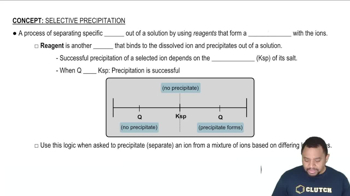
Selective precipitation is a technique used in analytical chemistry to separate ions in a solution based on their solubility. By adding specific reagents, certain ions will form insoluble compounds (precipitates) while others remain dissolved. This method is crucial for distinguishing between different groups of metal cations, as seen in the flowchart, which outlines the sequential addition of reagents to precipitate specific groups.
추천 영상:
가이드 코스
01:53
Selective Precipitation

Group 2 vs. Group 3 Sulfides

The sulfides precipitated in Group 2 are primarily acid-insoluble, meaning they do not dissolve in acidic conditions, while those in Group 3 are base-insoluble, indicating they remain undissolved in basic conditions. This distinction is significant because it affects the conditions under which these sulfides can be separated and identified during qualitative analysis, as shown in the flowchart.
추천 영상:

Precipitation Reagents

Precipitation reagents are chemicals added to a solution to induce the formation of a solid precipitate from dissolved ions. In the context of the flowchart, reagents like H2S and (NH4)2S are used to selectively precipitate sulfides from different groups of metal cations. Understanding the role of these reagents is essential for effectively separating and identifying metal ions in a mixture.
추천 영상:
가이드 코스
01:53
Selective Precipitation