Ch.17 - Additional Aspects of Aqueous Equilibria
Brown - Chemistry: The Central Science 14th Edition
Brown14th EditionChemistry: The Central ScienceISBN: 9780134414232당신이 사용하는 게 아니라요?교과서 변경
17장, 문제 84

Rainwater is acidic because CO21g2 dissolves in the water, creating carbonic acid, H2CO3. If the rainwater is too acidic, it will react with limestone and seashells (which are principally made of calcium carbonate, CaCO3). Calculate the concentrations of carbonic acid, bicarbonate ion 1HCO3-2 and carbonate ion 1CO32 - 2 that are in a raindrop that has a pH of 5.60, assuming that the sum of all three species in the raindrop is 1.0 * 10-5 M.

검증된 단계별 안내
1
Identify the relevant chemical equilibria: CO2 dissolves in water to form H2CO3, which can dissociate into HCO3^- and CO3^2-. The equilibria are: CO2 + H2O ⇌ H2CO3, H2CO3 ⇌ H^+ + HCO3^-, and HCO3^- ⇌ H^+ + CO3^2-.
Use the given pH to find the concentration of H^+ ions in the solution. Since pH = -log[H^+], calculate [H^+] from the pH of 5.60.
Apply the equilibrium expressions for the dissociation of H2CO3 into HCO3^- and CO3^2-. Use the known equilibrium constants for these reactions: K_a1 for H2CO3 ⇌ H^+ + HCO3^- and K_a2 for HCO3^- ⇌ H^+ + CO3^2-.
Set up the mass balance equation: [H2CO3] + [HCO3^-] + [CO3^2-] = 1.0 \(\times\) 10^{-5} M, which represents the total concentration of carbonic acid species in the raindrop.
Solve the system of equations using the equilibrium expressions and the mass balance equation to find the concentrations of H2CO3, HCO3^-, and CO3^2-.

비슷한 문제에 대한 검증된 영상 답변:

이 영상 해법은 위 문제에 도움이 된다고 튜터들이 추천한 것입니다.
영상 길이:
9m
도움이 되었나요?

주요 개념

질문에 올바르게 답하기 위해 반드시 이해해야 하는 핵심 개념들은 다음과 같습니다.

Acid-Base Chemistry

Acid-base chemistry involves the study of acids, bases, and their reactions. Acids donate protons (H+) in solution, while bases accept protons. The pH scale measures the acidity or basicity of a solution, with lower pH values indicating higher acidity. Understanding these principles is crucial for analyzing the behavior of carbonic acid in rainwater and its impact on the environment.
추천 영상:
가이드 코스
02:00
Arrhenius Acids and Bases

Carbonic Acid Equilibrium

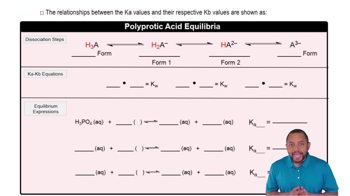
Carbonic acid (H2CO3) is a weak acid that exists in equilibrium with bicarbonate (HCO3-) and carbonate ions (CO32-). The equilibrium can be represented by the following reactions: H2CO3 ⇌ HCO3- + H+ and HCO3- ⇌ CO32- + H+. The pH of the solution influences the distribution of these species, making it essential to understand this equilibrium when calculating their concentrations in acidic rainwater.
추천 영상:
가이드 코스
6:47
Triprotic Acid Equilibrium

Concentration Calculations

Concentration calculations involve determining the amount of a substance in a given volume of solution, typically expressed in molarity (M). In this context, the total concentration of carbonic acid, bicarbonate, and carbonate ions is given as 1.0 * 10-5 M. Using the pH to find the concentration of H+ ions allows for the application of equilibrium expressions to calculate the individual concentrations of the species present in the raindrop.
추천 영상:
가이드 코스
07:35
Calculate Concentration of the Basic Form