You have to prepare a pH = 3.50 buffer, and you have the following 0.10 M solutions available: HCOOH, CH3COOH, H3PO4, HCOONa, CH3COONa, and NaH2PO4. How many milliliters of each solution would you use to make approximately 1 L of the buffer?

Ch.17 - Additional Aspects of Aqueous Equilibria
17장, 문제 29b
(b) What is the ratio of HCO3- to H2CO3 in an exhausted marathon runner whose blood pH is 7.1?
검증된 단계별 안내1
Identify the relevant chemical species involved, which are bicarbonate ion (HCO3-) and carbonic acid (H2CO3).
Use the Henderson-Hasselbalch equation for the bicarbonate buffer system in blood: pH = pKa + log([HCO3-]/[H2CO3]).
Find the pKa value of carbonic acid, which is typically around 6.1 at body temperature.
Substitute the given pH value (7.1) and the pKa value into the Henderson-Hasselbalch equation.
Solve the equation for the ratio [HCO3-]/[H2CO3] by isolating this term and using basic algebraic operations.

비슷한 문제에 대한 검증된 영상 답변:
이 영상 해법은 위 문제에 도움이 된다고 튜터들이 추천한 것입니다.
영상 길이:
2m주요 개념
질문에 올바르게 답하기 위해 반드시 이해해야 하는 핵심 개념들은 다음과 같습니다.
Buffer Systems
Buffer systems in the body, particularly the bicarbonate buffer system, help maintain pH levels in the blood. This system involves a dynamic equilibrium between carbonic acid (H2CO3) and bicarbonate ions (HCO3-), which can absorb excess hydrogen ions (H+) or release them to stabilize pH. Understanding this balance is crucial for analyzing changes in blood pH, especially in physiological conditions like exhaustion.
추천 영상:
가이드 코스
Buffer Capacity
Acid-Base Balance
Acid-base balance refers to the mechanisms the body uses to maintain a stable pH in the blood and other fluids. The normal blood pH range is approximately 7.35 to 7.45, and deviations can indicate metabolic or respiratory issues. In the case of an exhausted marathon runner with a pH of 7.1, this indicates acidosis, which can result from increased lactic acid production and depletion of bicarbonate.
추천 영상:
가이드 코스
Balancing Acidic Redox Reactions
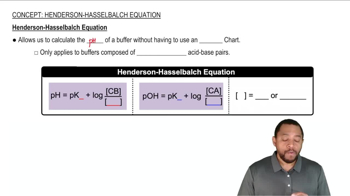
Henderson-Hasselbalch Equation
The Henderson-Hasselbalch equation relates the pH of a solution to the concentration ratio of an acid and its conjugate base. For the bicarbonate buffer system, it can be expressed as pH = pKa + log([HCO3-]/[H2CO3]). This equation is essential for calculating the ratio of bicarbonate to carbonic acid in the blood, allowing for a quantitative understanding of how the body compensates for changes in pH.
추천 영상:
가이드 코스
Henderson-Hasselbalch Equation
관련 실천
교과서 질문
교과서 질문
A buffer contains 0.10 mol of acetic acid and 0.13 mol of sodium acetate in 1.00 L. (c) What is the pH of the buffer after the addition of 0.02 mol of HNO3?
585
views
교과서 질문
(a) What is the ratio of HCO3- to H2CO3 in blood of pH 7.4?
1960
views
교과서 질문
You have to prepare a pH = 3.50 buffer, and you have the following 0.10 M solutions available: HCOOH, CH3COOH, H3PO4, HCOONa, CH3COONa, and NaH2PO4. Which solutions would you use?
1852
views
1
rank
교과서 질문
You have to prepare a pH = 5.00 buffer, and you have the following 0.10 M solutions available: HCOOH, HCOONa, CH3COOH, CH3COONa, HCN, and NaCN. Which solutions would you use?
747
views