You have to prepare a pH = 3.50 buffer, and you have the following 0.10 M solutions available: HCOOH, CH3COOH, H3PO4, HCOONa, CH3COONa, and NaH2PO4. How many milliliters of each solution would you use to make approximately 1 L of the buffer?

Ch.17 - Additional Aspects of Aqueous Equilibria
17장, 문제 32a
You have to prepare a pH = 5.00 buffer, and you have the following 0.10 M solutions available: HCOOH, HCOONa, CH3COOH, CH3COONa, HCN, and NaCN. Which solutions would you use?
검증된 단계별 안내1
insert step 1> Identify the pKa values of the acids available: HCOOH, CH3COOH, and HCN.
insert step 2> Compare the pKa values to the desired pH of the buffer, which is 5.00.
insert step 3> Choose the acid whose pKa is closest to the desired pH, as this will provide the most effective buffer.
insert step 4> Select the corresponding salt of the chosen acid to pair with it, forming the buffer system.
insert step 5> Use the Henderson-Hasselbalch equation to verify that the chosen acid and its conjugate base can achieve the desired pH.

비슷한 문제에 대한 검증된 영상 답변:
이 영상 해법은 위 문제에 도움이 된다고 튜터들이 추천한 것입니다.
영상 길이:
4m주요 개념
질문에 올바르게 답하기 위해 반드시 이해해야 하는 핵심 개념들은 다음과 같습니다.
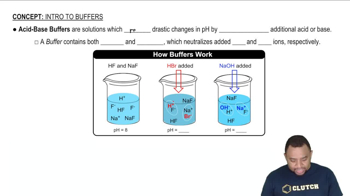
Buffer Solutions
Buffer solutions are mixtures that resist changes in pH when small amounts of acid or base are added. They typically consist of a weak acid and its conjugate base or a weak base and its conjugate acid. In this case, a buffer at pH 5.00 can be created using a weak acid and its salt, which helps maintain the desired pH level.
추천 영상:
가이드 코스
Buffer Solutions
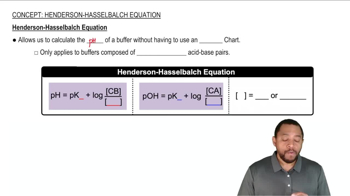
Henderson-Hasselbalch Equation
The Henderson-Hasselbalch equation relates the pH of a buffer solution to the concentration of the acid and its conjugate base. It is expressed as pH = pKa + log([A-]/[HA]), where pKa is the negative logarithm of the acid dissociation constant. This equation is essential for determining the appropriate ratio of acid to base needed to achieve a specific pH.
추천 영상:
가이드 코스
Henderson-Hasselbalch Equation
pKa Values
The pKa value is a measure of the strength of an acid in solution, indicating the pH at which half of the acid is dissociated. For effective buffer preparation, it is important to choose a weak acid with a pKa close to the desired pH. In this scenario, knowing the pKa values of the available acids (HCOOH, CH3COOH, HCN) will help identify which acid-base pair can effectively create a buffer at pH 5.00.
추천 영상:
가이드 코스
Gas Constant Values
관련 실천
교과서 질문
교과서 질문
(b) What is the ratio of HCO3- to H2CO3 in an exhausted marathon runner whose blood pH is 7.1?
542
views
교과서 질문
The accompanying graph shows the titration curves for two monoprotic acids. (d) Estimate the pKa of the weak acid.
561
views
교과서 질문
You have to prepare a pH = 5.00 buffer, and you have the following 0.10 M solutions available: HCOOH, HCOONa, CH3COOH, CH3COONa, HCN, and NaCN. How many milliliters of each solution would you use to make approximately 1 L of the buffer?
2216
views
교과서 질문
You have to prepare a pH = 3.50 buffer, and you have the following 0.10 M solutions available: HCOOH, CH3COOH, H3PO4, HCOONa, CH3COONa, and NaH2PO4. Which solutions would you use?
1852
views
1
rank