Calculate the pH at the equivalence point in titrating 0.100 M solutions of each of the following with 0.080 M NaOH: (b) chlorous acid (HClO2).
Ch.17 - Additional Aspects of Aqueous Equilibria
17장, 문제 48a
Calculate the pH at the equivalence point in titrating 0.100 M solutions of each of the following with 0.080 M NaOH: (a) hydrobromic acid (HBr).
검증된 단계별 안내1
Identify the type of acid involved in the titration. Hydrobromic acid (HBr) is a strong acid.
Recognize that at the equivalence point, the moles of acid equal the moles of base added. Since HBr is a strong acid, it will completely dissociate in water.
Write the balanced chemical equation for the reaction: \[ \text{HBr} + \text{NaOH} \rightarrow \text{NaBr} + \text{H}_2\text{O} \]
At the equivalence point, the solution contains the salt NaBr. Since NaBr is formed from a strong acid and a strong base, it does not affect the pH of the solution.
Conclude that the pH at the equivalence point for the titration of a strong acid with a strong base is neutral, which is a pH of 7.

비슷한 문제에 대한 검증된 영상 답변:
이 영상 해법은 위 문제에 도움이 된다고 튜터들이 추천한 것입니다.
영상 길이:
2m주요 개념
질문에 올바르게 답하기 위해 반드시 이해해야 하는 핵심 개념들은 다음과 같습니다.
Titration and Equivalence Point
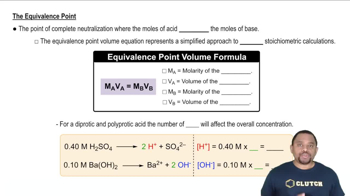
Titration is a quantitative analytical method used to determine the concentration of a solute in a solution. The equivalence point occurs when the amount of titrant added is stoichiometrically equivalent to the amount of analyte in the solution, resulting in complete neutralization. At this point, the pH of the solution is determined by the properties of the resulting solution, which can vary depending on the strength of the acid and base involved.
추천 영상:
가이드 코스
Equivalence Point in Titration
Strong Acid vs. Strong Base
Hydrobromic acid (HBr) is a strong acid that completely dissociates in solution, while sodium hydroxide (NaOH) is a strong base that also fully dissociates. In a titration involving a strong acid and a strong base, the pH at the equivalence point is typically neutral (pH 7) because the resulting solution contains only water and the salt formed from the acid and base, which does not affect the pH significantly.
추천 영상:
가이드 코스
Strong Acid-Strong Base Titration
pH Calculation
The pH is a measure of the hydrogen ion concentration in a solution, calculated using the formula pH = -log[H+]. At the equivalence point of a strong acid-strong base titration, the pH can be calculated based on the concentrations of the reactants and the volume of titrant added. Since both HBr and NaOH are strong, the resulting solution at the equivalence point will have a pH close to 7, indicating neutrality.
추천 영상:
가이드 코스
pH Calculation Example
관련 실천
교과서 질문
1291
views
교과서 질문
Calculate the pH at the equivalence point in titrating 0.100 M solutions of each of the following with 0.080 M NaOH: (c) benzoic acid (C6H5COOH).
653
views
교과서 질문
Calculate the pH at the equivalence point for titrating 0.200 M solutions of each of the following bases with 0.200 M HBr: (b) hydroxylamine 1NH2OH2.
1413
views
교과서 질문
Consider the titration of 30.0 mL of 0.050 M NH3 with 0.025 M HCl. Calculate the pH after the following volumes of titrant have been added: (e) 61.0 mL (f) 65.0 mL.
1955
views
교과서 질문
Calculate the pH at the equivalence point for titrating 0.200 M solutions of each of the following bases with 0.200 M HBr: (a) sodium hydroxide (NaOH).