Ch.17 - Additional Aspects of Aqueous Equilibria
Brown - Chemistry: The Central Science 14th Edition
Brown14th EditionChemistry: The Central ScienceISBN: 9780134414232당신이 사용하는 게 아니라요?교과서 변경
17장, 문제 19

Which of the following solutions is a buffer? (a) 0.10 M CH3COOH and 0.10 M CH3COONa, (b) 0.10 M CH3COOH, (c) 0.10 M HCl and 0.10 M NaCl, (d) both a and c, (e) all of a, b, and c.

검증된 단계별 안내
1
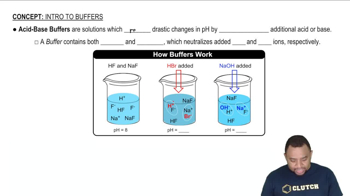
Step 1: Understand what a buffer solution is. A buffer solution is one that can resist changes in pH when small amounts of acid or base are added. It typically consists of a weak acid and its conjugate base, or a weak base and its conjugate acid.
Step 2: Analyze option (a): 0.10 M CH3COOH and 0.10 M CH3COONa. CH3COOH is a weak acid and CH3COONa provides the conjugate base, CH3COO-. This combination can act as a buffer.
Step 3: Analyze option (b): 0.10 M CH3COOH. This is only a weak acid without its conjugate base, so it cannot act as a buffer on its own.
Step 4: Analyze option (c): 0.10 M HCl and 0.10 M NaCl. HCl is a strong acid, and NaCl is a neutral salt. This combination does not provide a weak acid/base pair, so it cannot act as a buffer.
Step 5: Determine which options are buffers. Based on the analysis, option (a) is a buffer solution. Option (c) is not a buffer, and option (b) is not a buffer. Therefore, the correct answer is (a).

주요 개념

질문에 올바르게 답하기 위해 반드시 이해해야 하는 핵심 개념들은 다음과 같습니다.

Buffer Solutions

A buffer solution is a system that resists changes in pH upon the addition of small amounts of acid or base. It typically consists of a weak acid and its conjugate base or a weak base and its conjugate acid. This equilibrium allows the buffer to neutralize added acids or bases, maintaining a relatively stable pH.
추천 영상:
가이드 코스
03:02
Buffer Solutions

Weak Acids and Conjugate Bases

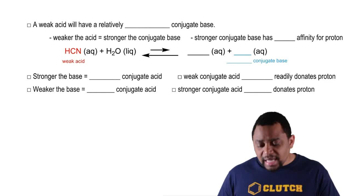
Weak acids are acids that do not completely dissociate in solution, meaning they establish an equilibrium between the undissociated acid and its ions. The conjugate base is formed when the weak acid donates a proton (H+). In the case of acetic acid (CH3COOH) and sodium acetate (CH3COONa), the acetic acid acts as the weak acid, while the acetate ion serves as its conjugate base.
추천 영상:
가이드 코스
01:46
Conjugate Acid-Base Relationships

Strong Acids vs. Weak Acids

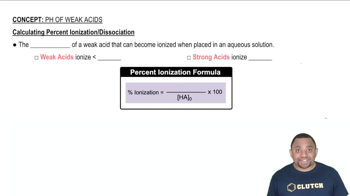
Strong acids, such as hydrochloric acid (HCl), completely dissociate in solution, releasing all their protons, which leads to a significant change in pH. In contrast, weak acids only partially dissociate, allowing for a more controlled pH environment. This distinction is crucial when identifying buffer solutions, as only combinations of weak acids and their conjugate bases can effectively function as buffers.
추천 영상:
가이드 코스
01:15
Calculating Percent Ionization of Weak Acids