Ch.18 - Chemistry of the Environment
Brown - Chemistry: The Central Science 14th Edition
Brown14th EditionChemistry: The Central ScienceISBN: 9780134414232당신이 사용하는 게 아니라요?교과서 변경
18장, 문제 18

In CF3Cl, the C-Cl bond dissociation energy is 339 kJ/mol. In CCl4, the C-Cl bond dissociation energy is 293 kJ/mol. What is the range of wavelengths of photons that can cause C-Cl bond rupture in one molecule but not in the other?

검증된 단계별 안내
1
Step 1: Understand the concept of bond dissociation energy, which is the energy required to break a bond in a molecule. Here, we have two different C-Cl bonds with different dissociation energies: 339 kJ/mol for CF3Cl and 293 kJ/mol for CCl4.
Step 2: Convert the bond dissociation energies from kJ/mol to energy per photon. Use the formula: Energy per photon (J) = (Bond dissociation energy (kJ/mol) * 1000 J/kJ) / Avogadro's number (6.022 x 10^23 mol^-1).
Step 3: Calculate the frequency of the photon required to break the bond using the energy per photon. Use the formula: Frequency (ν) = Energy per photon (J) / Planck's constant (6.626 x 10^-34 J·s).
Step 4: Convert the frequency to wavelength using the speed of light. Use the formula: Wavelength (λ) = Speed of light (c, approximately 3.00 x 10^8 m/s) / Frequency (ν).
Step 5: Determine the range of wavelengths that can break the C-Cl bond in one molecule but not the other by comparing the wavelengths calculated for CF3Cl and CCl4.

주요 개념

질문에 올바르게 답하기 위해 반드시 이해해야 하는 핵심 개념들은 다음과 같습니다.

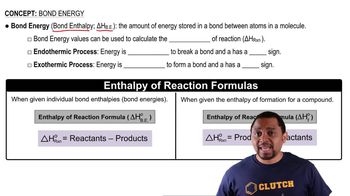
Bond Dissociation Energy

Bond dissociation energy (BDE) is the energy required to break a bond in a molecule, resulting in the formation of separate atoms or radicals. It is a crucial factor in determining the stability of a molecule; higher BDE indicates a stronger bond. In the context of the question, the differing BDEs of C-Cl bonds in CF3Cl and CCl4 suggest that different amounts of energy (and thus different photon wavelengths) are needed to break these bonds.
추천 영상:

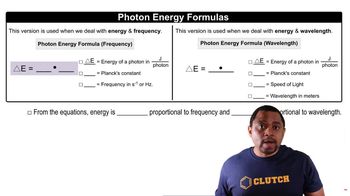
Photon Energy and Wavelength

The energy of a photon is inversely related to its wavelength, described by the equation E = hc/λ, where E is energy, h is Planck's constant, c is the speed of light, and λ is the wavelength. To cause bond rupture, the energy of the photon must match or exceed the bond dissociation energy. Therefore, the range of wavelengths that can cause C-Cl bond rupture in CF3Cl and CCl4 can be calculated based on their respective BDEs.
추천 영상:
가이드 코스
01:40
Photon Energy Formulas

Energy Threshold for Bond Rupture

The energy threshold for bond rupture is the minimum energy required to break a specific bond in a molecule. In this scenario, the C-Cl bond in CF3Cl has a higher energy threshold (339 kJ/mol) compared to CCl4 (293 kJ/mol). This difference means that photons with energies corresponding to wavelengths shorter than those calculated from these BDEs will be able to break the C-Cl bond in CF3Cl but not in CCl4, establishing a range of wavelengths for each molecule.
추천 영상: