Ch.18 - Chemistry of the Environment
Brown - Chemistry: The Central Science 14th Edition
Brown14th EditionChemistry: The Central ScienceISBN: 9780134414232당신이 사용하는 게 아니라요?교과서 변경
18장, 문제 17b

The dissociation energy of a carbon-bromine bond is typically about 276 kJ/mol. (b) Which kind of electromagnetic radiation—ultraviolet, visible, or infrared—does the wavelength you calculated in part (a) correspond to?

검증된 단계별 안내
1
First, understand that the dissociation energy given (276 kJ/mol) is the energy required to break one mole of carbon-bromine bonds.
Convert the dissociation energy from kJ/mol to J/photon. Since 1 kJ = 1000 J, multiply 276 kJ/mol by 1000 to convert to J/mol, then divide by Avogadro's number (6.022 x 10^23 mol^-1) to find the energy per photon.
Use the energy of a photon equation: E = h * c / λ, where E is the energy per photon, h is Planck's constant (6.626 x 10^-34 J·s), c is the speed of light (3.00 x 10^8 m/s), and λ is the wavelength in meters.
Rearrange the equation to solve for wavelength (λ): λ = h * c / E. Substitute the values for h, c, and the energy per photon calculated in the previous step to find the wavelength.
Compare the calculated wavelength to the typical ranges of electromagnetic radiation: ultraviolet (10 nm to 400 nm), visible (400 nm to 700 nm), and infrared (700 nm to 1 mm) to determine which type of radiation corresponds to the calculated wavelength.

비슷한 문제에 대한 검증된 영상 답변:

이 영상 해법은 위 문제에 도움이 된다고 튜터들이 추천한 것입니다.
영상 길이:
1m

주요 개념

질문에 올바르게 답하기 위해 반드시 이해해야 하는 핵심 개념들은 다음과 같습니다.

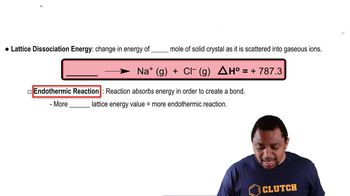
Dissociation Energy

Dissociation energy is the amount of energy required to break a bond between two atoms in a molecule, resulting in the formation of separate atoms. In this case, the dissociation energy of the carbon-bromine bond is 276 kJ/mol, indicating the energy needed to separate carbon and bromine atoms. Understanding this concept is crucial for relating energy changes to electromagnetic radiation.
추천 영상:

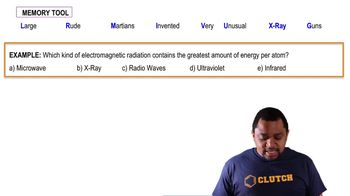
Electromagnetic Radiation

Electromagnetic radiation encompasses a range of waves, including ultraviolet, visible, and infrared light, characterized by their wavelength and energy. Each type of radiation corresponds to specific energy levels, with ultraviolet having higher energy and shorter wavelengths, while infrared has lower energy and longer wavelengths. This concept is essential for determining which type of radiation is associated with the energy calculated from the dissociation energy.
추천 영상:
가이드 코스
01:02
Electromagnetic Radiation Example

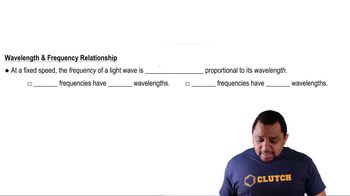
Wavelength and Energy Relationship

The relationship between wavelength and energy is described by the equation E = hc/λ, where E is energy, h is Planck's constant, c is the speed of light, and λ is the wavelength. This equation shows that shorter wavelengths correspond to higher energy photons, while longer wavelengths correspond to lower energy. Understanding this relationship is key to identifying the type of electromagnetic radiation based on the energy derived from the dissociation energy.
추천 영상:
가이드 코스
00:31
Frequency-Wavelength Relationship