Ch.18 - Chemistry of the Environment
Brown - Chemistry: The Central Science 14th Edition
Brown14th EditionChemistry: The Central ScienceISBN: 9780134414232당신이 사용하는 게 아니라요?교과서 변경
18장, 문제 37

What is the molarity of Na+ in a solution of NaCl whose salinity is 5.6 if the solution has a density of 1.03 g>mL?

검증된 단계별 안내
1
Understand that salinity is often expressed in parts per thousand (ppt), so a salinity of 5.6 means 5.6 grams of NaCl per 1000 grams of solution.
Calculate the mass of NaCl in 1 liter of solution using the density: 1.03 g/mL means 1030 g/L. Use the proportion: (5.6 g NaCl / 1000 g solution) = (x g NaCl / 1030 g solution).
Determine the moles of NaCl using its molar mass: NaCl has a molar mass of approximately 58.44 g/mol. Use the formula: moles = mass (g) / molar mass (g/mol).
Since NaCl dissociates into Na+ and Cl- ions in solution, the molarity of Na+ will be equal to the molarity of NaCl because each formula unit of NaCl produces one Na+ ion.
Calculate the molarity of Na+ by dividing the moles of NaCl by the volume of the solution in liters (1 L in this case).

비슷한 문제에 대한 검증된 영상 답변:

이 영상 해법은 위 문제에 도움이 된다고 튜터들이 추천한 것입니다.
영상 길이:
1m

주요 개념

질문에 올바르게 답하기 위해 반드시 이해해야 하는 핵심 개념들은 다음과 같습니다.

Molarity

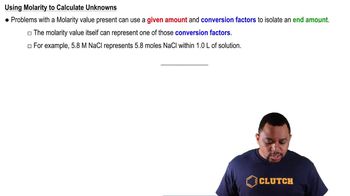
Molarity is a measure of concentration defined as the number of moles of solute per liter of solution. It is expressed in units of moles per liter (mol/L). To calculate molarity, one must know the amount of solute and the total volume of the solution. In this case, understanding how to convert salinity into moles of NaCl is essential for determining the molarity of Na+.
추천 영상:

Salinity

Salinity refers to the concentration of dissolved salts in water, typically expressed in parts per thousand (ppt) or grams per liter (g/L). In this context, a salinity of 5.6 indicates that there are 5.6 grams of NaCl per liter of solution. This value is crucial for calculating the number of moles of NaCl, which directly relates to the concentration of Na+ ions in the solution.

Density

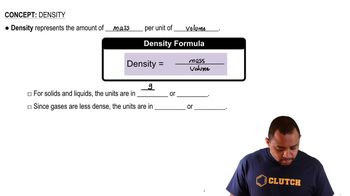
Density is defined as mass per unit volume and is typically expressed in grams per milliliter (g/mL) or kilograms per liter (kg/L). The density of the solution (1.03 g/mL) is important for converting the mass of the solution into volume, which is necessary for calculating molarity. Understanding how to use density to find the total volume of the solution helps in determining the concentration of Na+ ions.
추천 영상:
가이드 코스
01:56
Density Concepts
관련 실천
교과서 질문

Phosphorus is present in seawater to the extent of 0.07 ppm by mass. Assuming that the phosphorus is present as dihydrogenphosphate, H2PO4-, calculate the correspond-ing molar concentration of H2PO4- in seawater.

1073
views

교과서 질문

An important reaction in the formation of photochemical smog is the photodissociation of NO : NO2 + hv → NO(g) + O(g) The maximum wavelength of light that can cause this reac- tion is 420 nm. (a) In what part of the electromagnetic spec- trum is light with this wavelength found?

855
views
교과서 질문

The enthalpy of evaporation of water is 40.67 kJ/mol. Sunlight striking Earth's surface supplies 168 W per square meter (1 W = 1 watt = 1 J/s). (b) The specific heat capacity of liquid water is 4.184 J/g°C. If the initial surface temperature of a 1.00 square meter patch of ocean is 26 °C, what is its final temperature after being in sunlight for 12 h, assuming no phase changes and assuming that sunlight penetrates uniformly to depth of 10.0 cm?

1
views
교과서 질문

The enthalpy of evaporation of water is 40.67 kJ/mol. Sunlight striking Earth's surface supplies 168 W per square meter (1 W = 1 watt = 1 J/s). (a) Assuming that evaporation of water is due only to energy input from the Sun, calculate how many grams of water could be evaporated from a 1.00 square meter patch of ocean over a 12-h day

1570
views
교과서 질문

An important reaction in the formation of photochemical smog is the photodissociation of NO : NO2 + hv → NO(g) + O(g) The maximum wavelength of light that can cause this reaction is 420 nm. (b) What is the maximum strength of a bond, in kJ/mol, that can be broken by absorption of a photon of 420-nm light?