
Ch.19 - Chemical Thermodynamics
Brown - Chemistry: The Central Science 14th Edition
Brown14th EditionChemistry: The Central ScienceISBN: 9780134414232당신이 사용하는 게 아니라요?교과서 변경
19장, 문제 66

A certain constant-pressure reaction is barely nonspontaneous at 45 °C. The entropy change for the reaction is 72 J/K. Estimate ΔH.

검증된 단계별 안내
1
1. The spontaneity of a reaction is determined by the Gibbs free energy change (ΔG). If ΔG is negative, the reaction is spontaneous. If ΔG is positive, the reaction is nonspontaneous. In this case, we know the reaction is barely nonspontaneous, so ΔG is slightly positive.
2. The Gibbs free energy change is given by the equation ΔG = ΔH - TΔS, where ΔH is the enthalpy change, T is the temperature in Kelvin, and ΔS is the entropy change. We need to solve this equation for ΔH, which gives us ΔH = ΔG + TΔS.
3. We know that ΔG is slightly positive, but we don't know its exact value. However, because the reaction is barely nonspontaneous, we can assume that ΔG is very close to zero. This simplifies our equation to ΔH ≈ TΔS.
4. Convert the temperature from Celsius to Kelvin by adding 273.15 to the Celsius temperature. So, T = 45°C + 273.15 = 318.15 K.
5. Substitute the values of T and ΔS into the equation from step 3 to estimate ΔH. Remember to keep the units consistent, so convert the entropy change from J/K to kJ/K by dividing by 1000 if necessary.

비슷한 문제에 대한 검증된 영상 답변:

이 영상 해법은 위 문제에 도움이 된다고 튜터들이 추천한 것입니다.
영상 길이:
2m

주요 개념

질문에 올바르게 답하기 위해 반드시 이해해야 하는 핵심 개념들은 다음과 같습니다.

Gibbs Free Energy

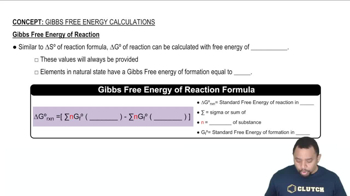
Gibbs Free Energy (ΔG) is a thermodynamic potential that helps predict the spontaneity of a reaction. A reaction is spontaneous when ΔG is negative. At equilibrium, ΔG equals zero, and for a reaction to be barely nonspontaneous, ΔG is close to zero, indicating that the enthalpy and entropy changes are in a delicate balance.
추천 영상:
가이드 코스
01:51
Gibbs Free Energy of Reactions

Entropy Change (ΔS)

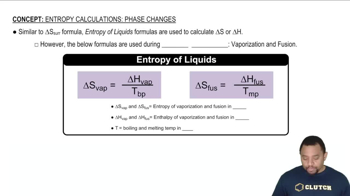
Entropy change (ΔS) measures the degree of disorder or randomness in a system. In this context, a positive ΔS of 72 J/K suggests that the reaction increases the disorder of the system. This increase in entropy can drive a reaction towards spontaneity, but it must be balanced with the enthalpy change (ΔH) to determine the overall spontaneity through Gibbs Free Energy.
추천 영상:
가이드 코스
01:46
Entropy in Phase Changes

Enthalpy Change (ΔH)

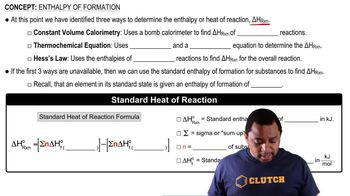
Enthalpy change (ΔH) represents the heat content of a system at constant pressure. It is a crucial factor in determining the energy required or released during a reaction. In the context of the question, we can use the relationship ΔG = ΔH - TΔS to estimate ΔH, knowing that the reaction is barely nonspontaneous at a specific temperature (45 °C).
추천 영상:
가이드 코스
02:34
Enthalpy of Formation