
Ch.19 - Chemical Thermodynamics
Brown - Chemistry: The Central Science 14th Edition
Brown14th EditionChemistry: The Central ScienceISBN: 9780134414232당신이 사용하는 게 아니라요?교과서 변경
19장, 문제 63c

Classify each of the following reactions as one of the four possible types summarized in Table 19.3: (i) spontaneous at all temperatures; (ii) not spontaneous at any temperature; (iii) spontaneous at low T but not spontaneous at high T; (iv) spontaneous at high T but not spontaneous at low T.
(c) N2F4(g) ⟶ 2 NF2(g) ΔH° = 85 kJ; ΔS° = 198 J/K

검증된 단계별 안내
1
Identify the given values: \( \Delta H^\circ = 85 \text{ kJ} \) and \( \Delta S^\circ = 198 \text{ J/K} \).
Convert \( \Delta S^\circ \) from \( \text{J/K} \) to \( \text{kJ/K} \) by dividing by 1000, so \( \Delta S^\circ = 0.198 \text{ kJ/K} \).
Use the Gibbs free energy equation: \( \Delta G^\circ = \Delta H^\circ - T \Delta S^\circ \).
Determine the sign of \( \Delta G^\circ \) at different temperatures: \( \Delta G^\circ \) is positive when \( \Delta H^\circ > T \Delta S^\circ \) and negative when \( \Delta H^\circ < T \Delta S^\circ \).
Since \( \Delta H^\circ > 0 \) and \( \Delta S^\circ > 0 \), the reaction is spontaneous at high temperatures but not at low temperatures.

비슷한 문제에 대한 검증된 영상 답변:

이 영상 해법은 위 문제에 도움이 된다고 튜터들이 추천한 것입니다.
영상 길이:
1m

주요 개념

질문에 올바르게 답하기 위해 반드시 이해해야 하는 핵심 개념들은 다음과 같습니다.

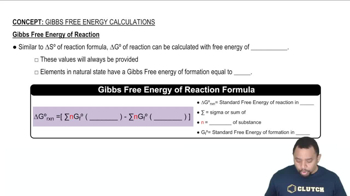
Gibbs Free Energy

Gibbs Free Energy (G) is a thermodynamic potential that helps predict the spontaneity of a reaction at constant temperature and pressure. The change in Gibbs Free Energy (ΔG) is calculated using the equation ΔG = ΔH - TΔS, where ΔH is the change in enthalpy, T is the temperature in Kelvin, and ΔS is the change in entropy. A negative ΔG indicates a spontaneous reaction, while a positive ΔG suggests non-spontaneity.
추천 영상:
가이드 코스
01:51
Gibbs Free Energy of Reactions

Enthalpy and Entropy

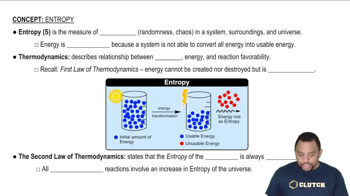
Enthalpy (ΔH) is a measure of the total heat content of a system, while entropy (ΔS) quantifies the degree of disorder or randomness in a system. In chemical reactions, the balance between enthalpy and entropy changes determines whether a reaction is spontaneous. For example, reactions that release heat (exothermic, ΔH < 0) and increase disorder (ΔS > 0) are typically spontaneous.
추천 영상:
가이드 코스
02:46
Entropy in Thermodynamics

Temperature Dependence of Spontaneity

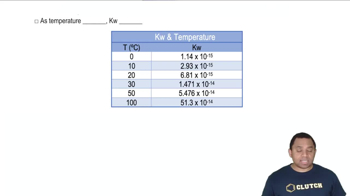
The spontaneity of a reaction can depend on temperature, as indicated by the Gibbs Free Energy equation. At low temperatures, reactions with negative ΔH and positive ΔS are favored, while at high temperatures, reactions with positive ΔS can become spontaneous even if ΔH is positive. Understanding this temperature dependence is crucial for classifying reactions into the four types of spontaneity.
추천 영상:
가이드 코스
01:24
Kw Temperature Dependence