

Ch.19 - Chemical Thermodynamics
Brown - Chemistry: The Central Science 14th Edition
Brown14th EditionChemistry: The Central ScienceISBN: 9780134414232당신이 사용하는 게 아니라요?교과서 변경
19장, 문제 18

(b) Without further information, can you conclude whether the amount of heat transferred to the system as it goes from state 1 to state 2 is the same or different compared to that upon going from state 2 back to state 1?

검증된 단계별 안내
1
Understand the concept of heat transfer in thermodynamics: Heat transfer is the process of energy moving from one system to another due to temperature difference. In thermodynamics, the amount of heat transferred depends on the path taken between two states.
Recognize that the problem involves a thermodynamic process between two states: State 1 and State 2. The question asks about the heat transfer when moving from State 1 to State 2 and then back from State 2 to State 1.
Recall that heat transfer is a path function, not a state function: Unlike state functions (such as internal energy, pressure, and volume), path functions depend on the specific process or path taken. Therefore, the heat transferred can vary depending on how the system transitions between states.
Consider the implications of path dependency: Without additional information about the specific processes or paths taken between State 1 and State 2, it is not possible to conclude whether the heat transferred is the same or different. Different paths can result in different amounts of heat transfer.
Conclude that more information is needed: To determine if the heat transferred is the same or different, details about the processes or paths taken between the states are necessary. This could include information about pressure, volume changes, or specific heat capacities involved in the transitions.

주요 개념

질문에 올바르게 답하기 위해 반드시 이해해야 하는 핵심 개념들은 다음과 같습니다.

First Law of Thermodynamics

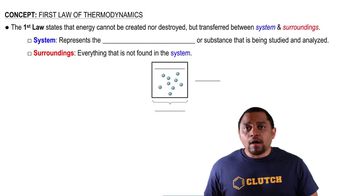
The First Law of Thermodynamics states that energy cannot be created or destroyed, only transformed from one form to another. In the context of heat transfer, this means that the total energy change in a system is equal to the heat added to the system minus the work done by the system. This principle is crucial for understanding how heat transfer relates to changes in a system's internal energy.
추천 영상:
가이드 코스
01:18
First Law of Thermodynamics

Path Dependence of Heat Transfer

Heat transfer is path-dependent, meaning that the amount of heat exchanged between a system and its surroundings can vary based on the specific process or path taken. For example, the heat transferred during a reversible process may differ from that in an irreversible process, even if the initial and final states are the same. This concept is essential for analyzing thermodynamic cycles and understanding the differences in heat transfer between state changes.
추천 영상:

State Functions

State functions are properties of a system that depend only on its current state, not on the path taken to reach that state. Examples include internal energy, enthalpy, and pressure. In the context of the question, while the heat transferred may differ depending on the path, the change in internal energy between state 1 and state 2 is a state function, allowing us to analyze the system's energy changes without needing to know the specific heat transfer details.
추천 영상:
가이드 코스
03:37
Logarithmic Functions
관련 실천
교과서 질문

A system goes from state 1 to state 2 and back to state 1. (c) Suppose the changes in state are reversible processes. Is the work done by the system upon going from state 1 to state 2 the same or different as compared to that upon going from state 2 back to state 1?

675
views
교과서 질문

Consider a process in which an ideal gas changes from state 1 to state 2 in such a way that its temperature changes from 300 K to 200 K. (b) Is this process isothermal?

505
views
교과서 질문

Indicate whether each statement is true or false. (a) ΔS is a state function. (b) If a system undergoes a reversible change, the entropy of the universe increases. (c) If a system undergoes a reversible process, the change in entropy of the system is exactly matched by an equal and opposite change in the entropy of the surroundings. (d) If a system undergoes a reversible process, the entropy change of the system must be zero.

919
views
교과서 질문
Consider a system consisting of an ice cube. (a) Under what conditions can the ice cube melt reversibly?
477
views
교과서 질문

Consider a process in which an ideal gas changes from state 1 to state 2 in such a way that its temperature changes from 300 K to 200 K. (a) Does the temperature change depend on whether the process is reversible or irreversible?

548
views
교과서 질문

Consider a process in which an ideal gas changes from state 1 to state 2 in such a way that its temperature changes from 300 K to 200 K. (c) Does the change in the internal energy, ΔE, depend on the particular pathway taken to carry out this change of state?

625
views
1
rank