Ch.19 - Chemical Thermodynamics
Brown - Chemistry: The Central Science 14th Edition
Brown14th EditionChemistry: The Central ScienceISBN: 9780134414232당신이 사용하는 게 아니라요?교과서 변경
19장, 문제 18c

A system goes from state 1 to state 2 and back to state 1. (c) Suppose the changes in state are reversible processes. Is the work done by the system upon going from state 1 to state 2 the same or different as compared to that upon going from state 2 back to state 1?

검증된 단계별 안내
1
insert step 1: Understand the concept of reversible processes. In a reversible process, the system is in equilibrium with its surroundings at every step, meaning the process can be reversed by an infinitesimal change in a variable.
insert step 2: Recall that in thermodynamics, work done by the system is path-dependent. This means that the work done depends on the path taken between two states, not just the initial and final states.
insert step 3: Consider the fact that if the process is truly reversible, the path taken from state 1 to state 2 is the same as the path taken from state 2 back to state 1, but in reverse.
insert step 4: Since the path is the same (just reversed), the magnitude of the work done by the system from state 1 to state 2 will be the same as the magnitude of the work done from state 2 back to state 1.
insert step 5: Conclude that for reversible processes, the work done by the system upon going from state 1 to state 2 is the same as the work done upon going from state 2 back to state 1, but with opposite signs, as the direction of the process is reversed.

비슷한 문제에 대한 검증된 영상 답변:

이 영상 해법은 위 문제에 도움이 된다고 튜터들이 추천한 것입니다.
영상 길이:
1m
도움이 되었나요?

주요 개념

질문에 올바르게 답하기 위해 반드시 이해해야 하는 핵심 개념들은 다음과 같습니다.

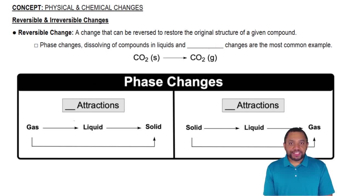
Reversible Processes

Reversible processes are idealized thermodynamic processes that can be reversed without leaving any change in the system or surroundings. In such processes, the system is always in equilibrium, and the path taken from one state to another can be retraced exactly. This concept is crucial for understanding how work and energy transfer occur in thermodynamic cycles.
추천 영상:
가이드 코스
03:40
Reversible Changes in Matter

Work in Thermodynamics

In thermodynamics, work is defined as the energy transferred when a force is applied over a distance. The work done by a system during a process depends on the path taken between the initial and final states. For reversible processes, the work done from state 1 to state 2 is equal in magnitude but opposite in sign to the work done from state 2 back to state 1, highlighting the conservation of energy.
추천 영상:
가이드 코스
01:18
First Law of Thermodynamics

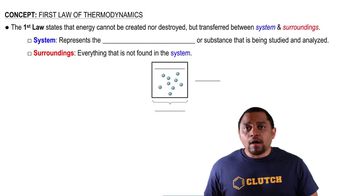
First Law of Thermodynamics

The First Law of Thermodynamics states that energy cannot be created or destroyed, only transformed from one form to another. This principle implies that the total energy change in a closed system is equal to the heat added to the system minus the work done by the system. Understanding this law is essential for analyzing energy transfers during reversible processes and determining the relationship between work and internal energy changes.
추천 영상:
가이드 코스
01:18
First Law of Thermodynamics