


Ch.19 - Chemical Thermodynamics
Brown - Chemistry: The Central Science 14th Edition
Brown14th EditionChemistry: The Central ScienceISBN: 9780134414232당신이 사용하는 게 아니라요?교과서 변경
19장, 문제 30a

(a) What is the difference between a state and a microstate of a system?

검증된 단계별 안내
1
Understand that a 'state' of a system in thermodynamics refers to the macroscopic condition of the system, which is described by variables such as pressure, volume, temperature, and composition. These variables provide a comprehensive overview of the system at a macroscopic level.
Recognize that a 'microstate', on the other hand, refers to a specific detailed arrangement of each molecule in the system at any given instant. Microstates account for the positions and energies of all the molecules, which are not observable at the macroscopic level.
Learn that while the macroscopic state remains the same, the system can switch between countless microstates. For example, in a gas contained in a box, the overall temperature and pressure (macroscopic state) might be constant, but the individual positions and velocities of the gas molecules (microstates) are constantly changing.
Realize that the number of microstates is related to the entropy of the system, where a greater number of microstates corresponds to higher entropy. This relationship is quantified in statistical thermodynamics, which connects microscopic behavior with macroscopic properties.
Appreciate that understanding both the state and microstates of a system provides a more complete picture of the system's behavior from both a macroscopic and microscopic perspective, which is crucial for deeper insights in thermodynamics and statistical mechanics.

비슷한 문제에 대한 검증된 영상 답변:

이 영상 해법은 위 문제에 도움이 된다고 튜터들이 추천한 것입니다.
영상 길이:
1m
도움이 되었나요?

주요 개념

질문에 올바르게 답하기 위해 반드시 이해해야 하는 핵심 개념들은 다음과 같습니다.

State of a System

A state of a system refers to the macroscopic properties that define the system at a given moment, such as temperature, pressure, and volume. These properties are measurable and provide a comprehensive description of the system's overall condition. For example, a gas in a container can be described by its temperature and pressure, which together define its state.
추천 영상:
가이드 코스
02:06
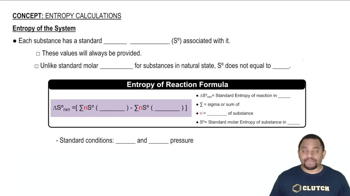
Entropy of the System

Microstate

A microstate is a specific configuration of a system at the microscopic level, detailing the exact positions and energies of all particles within the system. Each microstate corresponds to a particular arrangement of particles, and many microstates can correspond to the same macroscopic state. For instance, in a gas, the different ways in which molecules can be arranged while maintaining the same temperature and pressure represent different microstates.
추천 영상:
가이드 코스
01:23
The Boltzmann Equation

Statistical Mechanics

Statistical mechanics is a branch of physics that connects the microscopic properties of individual particles to the macroscopic properties of materials. It uses statistical methods to explain how the behavior of large numbers of particles leads to observable phenomena, such as temperature and pressure. This framework helps in understanding how many microstates correspond to a given state, thereby linking thermodynamics and quantum mechanics.
추천 영상:
가이드 코스
03:06
Reaction Mechanism Overview