Ch.19 - Chemical Thermodynamics
Brown - Chemistry: The Central Science 14th Edition
Brown14th EditionChemistry: The Central ScienceISBN: 9780134414232당신이 사용하는 게 아니라요?교과서 변경
19장, 문제 30b

(b) As a system goes from state A to state B, its entropy decreases. What can you say about the number of microstates corresponding to each state?

검증된 단계별 안내
1
Understand the concept of entropy in thermodynamics, which is a measure of the disorder or randomness in a system. It is related to the number of microstates (W), which are the different ways in which the system's particles can be arranged while still having the same total energy.
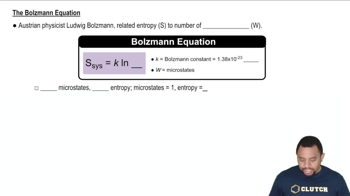
Recognize that entropy (S) is related to the number of microstates by the Boltzmann's equation, S = k \(\ln\)(W), where k is the Boltzmann constant and W is the number of microstates.
Identify that a decrease in entropy, as the system goes from state A to state B, implies that the number of microstates in state B is less than in state A. This is because a decrease in entropy suggests a decrease in disorder or randomness, meaning fewer possible arrangements of particles.
Conclude that since the entropy decreases from state A to state B, state A has more microstates compared to state B. This means that state A is more disordered or has more configurations at the microscopic level compared to state B.
Apply this understanding to predict the behavior of systems in different scenarios, considering how changes in entropy reflect changes in the number of microstates and thus the disorder of the system.

비슷한 문제에 대한 검증된 영상 답변:

이 영상 해법은 위 문제에 도움이 된다고 튜터들이 추천한 것입니다.
영상 길이:
1m
도움이 되었나요?

주요 개념

질문에 올바르게 답하기 위해 반드시 이해해야 하는 핵심 개념들은 다음과 같습니다.

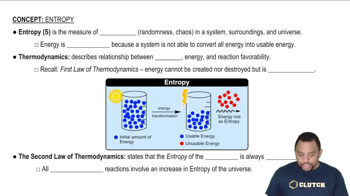
Entropy

Entropy is a measure of the disorder or randomness in a system. In thermodynamics, it quantifies the number of ways a system can be arranged at the microscopic level, with higher entropy indicating more disorder. When a system transitions from a state of higher entropy to lower entropy, it suggests a decrease in the number of accessible microstates.
추천 영상:
가이드 코스
02:46
Entropy in Thermodynamics

Microstates

Microstates refer to the specific configurations of a system at the molecular or atomic level that correspond to a particular macroscopic state. Each microstate represents a unique arrangement of particles, and the total number of microstates determines the entropy of the system. A decrease in entropy implies that the number of microstates available to the system has also decreased.
추천 영상:
가이드 코스
01:23
The Boltzmann Equation

Second Law of Thermodynamics

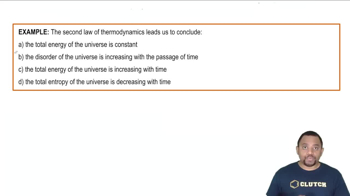
The Second Law of Thermodynamics states that in an isolated system, the total entropy can never decrease over time. This law implies that processes tend to move towards a state of greater disorder. However, in specific scenarios, such as the transition from state A to state B, if the entropy decreases, it may indicate that the system is interacting with its surroundings, leading to a net increase in the entropy of the universe.
추천 영상:
가이드 코스
00:48
Second Law of Thermodynamics Example