For a certain chemical reaction, ΔH° = -35.4 kJ and ΔS° = -85.5 J/K. (b) Does the reaction lead to an increase or decrease in the randomness or disorder of the system?
Ch.19 - Chemical Thermodynamics
19장, 문제 53b
(b) For a certain process that occurs at constant T and P, the value of ΔG is positive. Is the process spontaneous?
검증된 단계별 안내1
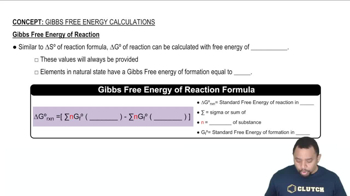
Understand the concept of Gibbs Free Energy (ΔG): Gibbs Free Energy is a thermodynamic potential that can be used to predict the spontaneity of a process at constant temperature and pressure.
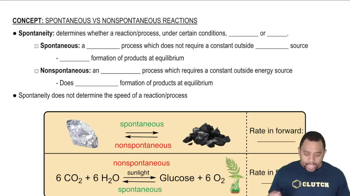
Recall the spontaneity criterion: A process is spontaneous if the change in Gibbs Free Energy (ΔG) is negative. If ΔG is positive, the process is non-spontaneous under the given conditions.
Analyze the given condition: The problem states that ΔG is positive for the process occurring at constant temperature and pressure.
Apply the spontaneity criterion to the given condition: Since ΔG is positive, according to the criterion, the process is not spontaneous.
Conclude based on the analysis: The process is non-spontaneous at constant temperature and pressure because the value of ΔG is positive.

비슷한 문제에 대한 검증된 영상 답변:
이 영상 해법은 위 문제에 도움이 된다고 튜터들이 추천한 것입니다.
영상 길이:
1m주요 개념
질문에 올바르게 답하기 위해 반드시 이해해야 하는 핵심 개념들은 다음과 같습니다.
Gibbs Free Energy (ΔG)
Gibbs Free Energy (ΔG) is a thermodynamic potential that measures the maximum reversible work obtainable from a thermodynamic system at constant temperature and pressure. A negative ΔG indicates that a process can occur spontaneously, while a positive ΔG suggests that the process is non-spontaneous under the given conditions.
추천 영상:
가이드 코스
Gibbs Free Energy of Reactions
Spontaneity of Reactions
The spontaneity of a reaction refers to its ability to proceed without external intervention. A spontaneous process is characterized by a decrease in free energy (ΔG < 0), meaning it can occur naturally. Conversely, if ΔG is positive, the process is not spontaneous and requires energy input to occur.
추천 영상:
가이드 코스
Spontaneity of Processes
Thermodynamic Equilibrium
Thermodynamic equilibrium is the state of a system where macroscopic properties are uniform and do not change over time. At equilibrium, the Gibbs Free Energy is at a minimum, and any process that would increase ΔG is not spontaneous. A positive ΔG indicates that the system is not at equilibrium and will not proceed spontaneously in the forward direction.
추천 영상:
가이드 코스
First Law of Thermodynamics
관련 실천
교과서 질문
647
views
교과서 질문
(a) For a process that occurs at constant temperature, does the change in Gibbs free energy depend on changes in the enthalpy and entropy of the system?
869
views
교과서 질문
Using S° values from Appendix C, calculate ΔS° values for the following reactions. In each case, account for the sign of ΔS°.
(a) C2H4(g) + H2(g) → C2H6(g)
(b) N2O4(g) → 2 NO2(g)
(c) Be(OH)2(s) → BeO(s) + H2O(g)
(d) 2 CH3OH(g) + 3 O2(g) ⟶ 2 CO2(g) + 4 H2O(g)
1507
views
교과서 질문
For a certain chemical reaction, ΔH° = -35.4 kJ and ΔS° = -85.5 J/K. (c) Calculate ΔG° for the reaction at 298 K. (d) Is the reaction spontaneous at 298 K under standard conditions?
1
views