Ch.19 - Chemical Thermodynamics
Brown - Chemistry: The Central Science 14th Edition
Brown14th EditionChemistry: The Central ScienceISBN: 9780134414232당신이 사용하는 게 아니라요?교과서 변경
19장, 문제 51

Using S° values from Appendix C, calculate ΔS° values for the following reactions. In each case, account for the sign of ΔS°.
(a) C2H4(g) + H2(g) → C2H6(g)
(b) N2O4(g) → 2 NO2(g)
(c) Be(OH)2(s) → BeO(s) + H2O(g)
(d) 2 CH3OH(g) + 3 O2(g) ⟶ 2 CO2(g) + 4 H2O(g)

검증된 단계별 안내
1
Identify the standard entropy (S°) values for each reactant and product from Appendix C. You will need the S° values for CH₃OH(g), O₂(g), CO₂(g), and H₂O(g).
Multiply the S° value of each reactant and product by their respective stoichiometric coefficients in the balanced chemical equation. For reactants: 2 S°(CH₃OH(g)) + 3 S°(O₂(g)), and for products: 2 S°(CO₂(g)) + 4 S°(H₂O(g)).
Sum up the total S° values for all reactants and all products separately. This will give you two totals: one for the reactants and one for the products.
Calculate the change in entropy (ΔS°) for the reaction by subtracting the total S° value of the reactants from the total S° value of the products: ΔS° = [2 S°(CO₂(g)) + 4 S°(H₂O(g))] - [2 S°(CH₃OH(g)) + 3 S°(O₂(g))].
Analyze the sign of ΔS°. If ΔS° is positive, it indicates an increase in disorder or randomness in the system as the reaction proceeds. If ΔS° is negative, it indicates a decrease in disorder.

비슷한 문제에 대한 검증된 영상 답변:

이 영상 해법은 위 문제에 도움이 된다고 튜터들이 추천한 것입니다.
영상 길이:
2m
도움이 되었나요?

주요 개념

질문에 올바르게 답하기 위해 반드시 이해해야 하는 핵심 개념들은 다음과 같습니다.

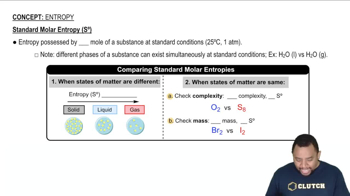
Standard Entropy (S°)

Standard entropy (S°) is a measure of the randomness or disorder of a system at a standard state, typically defined at 1 bar of pressure and a specified temperature, usually 298 K. It reflects the number of accessible microstates for a given substance, with higher values indicating greater disorder. In chemical reactions, the change in entropy (ΔS°) can be calculated by considering the standard entropies of the reactants and products.
추천 영상:
가이드 코스
03:33
Standard Molar Entropy

Entropy Change (ΔS°)

The change in entropy (ΔS°) for a reaction is calculated using the formula ΔS° = ΣS°(products) - ΣS°(reactants). This value indicates whether the disorder of the system increases or decreases during the reaction. A positive ΔS° suggests an increase in disorder, while a negative ΔS° indicates a decrease. Understanding the sign of ΔS° is crucial for predicting the spontaneity of a reaction.
추천 영상:
가이드 코스
01:46
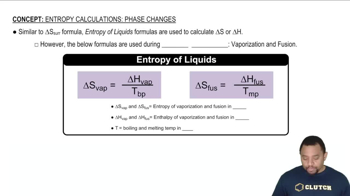
Entropy in Phase Changes

Gas Phase Reactions and Entropy

In gas phase reactions, the number of moles of gaseous reactants and products significantly influences the entropy change. Generally, reactions that produce more gas molecules than they consume lead to an increase in entropy (positive ΔS°), while those that consume more gas molecules result in a decrease in entropy (negative ΔS°). This concept is essential for analyzing the given reaction, where the number of gaseous reactants and products must be compared to determine the sign of ΔS°.
추천 영상:
가이드 코스
01:46
Entropy in Phase Changes