Ch.19 - Chemical Thermodynamics
Brown - Chemistry: The Central Science 14th Edition
Brown14th EditionChemistry: The Central ScienceISBN: 9780134414232당신이 사용하는 게 아니라요?교과서 변경
19장, 문제 34b

(b) How does the entropy of the system change in the processes described in Exercise 19.12?

검증된 단계별 안내
1
Identify the processes described in Exercise 19.12. These processes could involve changes in physical state, mixing of substances, or chemical reactions. Understanding the nature of these processes is crucial for analyzing entropy changes.
Recall the concept of entropy. Entropy is a measure of the disorder or randomness in a system. Generally, processes that increase disorder (such as melting, vaporization, or mixing) result in an increase in entropy, while processes that decrease disorder (such as freezing or condensation) result in a decrease in entropy.
For each process, determine whether the system becomes more ordered or more disordered. For example, if a solid melts into a liquid, the system becomes more disordered, indicating an increase in entropy.
Consider the molecular perspective: Analyze how the movement and arrangement of molecules change during each process. Increased molecular motion and dispersion typically lead to higher entropy.
Summarize the entropy changes for each process. State whether the entropy of the system increases, decreases, or remains unchanged based on the analysis of molecular disorder and the nature of the process.

비슷한 문제에 대한 검증된 영상 답변:

이 영상 해법은 위 문제에 도움이 된다고 튜터들이 추천한 것입니다.
영상 길이:
3m
도움이 되었나요?

주요 개념

질문에 올바르게 답하기 위해 반드시 이해해야 하는 핵심 개념들은 다음과 같습니다.

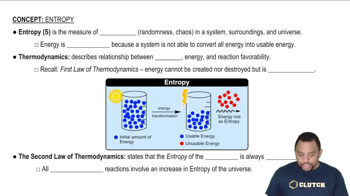
Entropy

Entropy is a measure of the disorder or randomness in a system. In thermodynamics, it quantifies the number of microscopic configurations that correspond to a thermodynamic system's macroscopic state. A higher entropy indicates a greater degree of disorder, while a lower entropy suggests more order. Understanding how entropy changes during processes is crucial for predicting the spontaneity and direction of chemical reactions.
추천 영상:
가이드 코스
02:46
Entropy in Thermodynamics

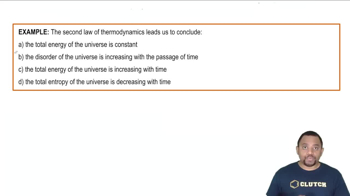
Second Law of Thermodynamics

The Second Law of Thermodynamics states that the total entropy of an isolated system can never decrease over time. It implies that natural processes tend to move towards a state of maximum disorder or entropy. This law is fundamental in determining whether a process is spontaneous; if the entropy of the universe increases, the process is likely to occur. This principle is essential for analyzing changes in entropy during chemical reactions or physical transformations.
추천 영상:
가이드 코스
00:48
Second Law of Thermodynamics Example

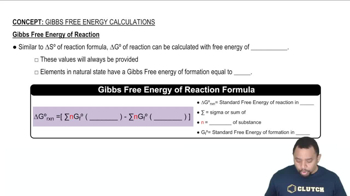
Gibbs Free Energy

Gibbs Free Energy (G) is a thermodynamic potential that measures the maximum reversible work obtainable from a system at constant temperature and pressure. It combines the system's enthalpy and entropy to determine spontaneity; a negative change in Gibbs Free Energy (ΔG < 0) indicates a spontaneous process. Understanding Gibbs Free Energy is crucial for analyzing how entropy changes in various processes, as it directly relates to the balance between enthalpy and entropy.
추천 영상:
가이드 코스
01:51
Gibbs Free Energy of Reactions