Consider the decomposition of barium carbonate: BaCO3(s) ⇌ BaO(s) + CO2(g) Using data from Appendix C, calculate the equilibrium pressure of CO2 at (b) 1100 K.
Ch.19 - Chemical Thermodynamics
19장, 문제 81a
Consider the decomposition of barium carbonate: BaCO3(s) ⇌ BaO(s) + CO2(g) Using data from Appendix C, calculate the equilibrium pressure of CO2 at (a) 298 K.
검증된 단계별 안내1
Identify the reaction: BaCO_3(s) \(\rightleftharpoons\) BaO(s) + CO_2(g).
Use the standard Gibbs free energy change (\(\Delta\) G^\(\circ\)) for the reaction to find the equilibrium constant (K) at 298 K. \(\Delta\) G^\(\circ\) = \(\sum\) \(\Delta\) G^\(\circ\)_{\(\text{products}\)} - \(\sum\) \(\Delta\) G^\(\circ\)_{\(\text{reactants}\)}.
Calculate \(\Delta\) G^\(\circ\) using the values from Appendix C for BaCO_3, BaO, and CO_2.
Relate \(\Delta\) G^\(\circ\) to the equilibrium constant using the equation \(\Delta\) G^\(\circ\) = -RT \(\ln\) K, where R is the gas constant (8.314 J/mol·K) and T is the temperature in Kelvin.
Solve for K, which is equal to the equilibrium pressure of CO_2, since the reaction involves only one gaseous product.

비슷한 문제에 대한 검증된 영상 답변:
이 영상 해법은 위 문제에 도움이 된다고 튜터들이 추천한 것입니다.
영상 길이:
5m도움이 되었나요?
주요 개념
질문에 올바르게 답하기 위해 반드시 이해해야 하는 핵심 개념들은 다음과 같습니다.
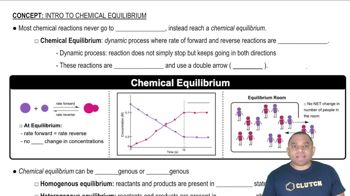
Chemical Equilibrium
Chemical equilibrium occurs when the rates of the forward and reverse reactions are equal, resulting in constant concentrations of reactants and products. In the context of the decomposition of barium carbonate, the system reaches equilibrium when the amount of BaCO3 decomposing into BaO and CO2 is balanced by the amount of CO2 reacting back to form BaCO3.
추천 영상:
가이드 코스
Chemical Equilibrium Concepts
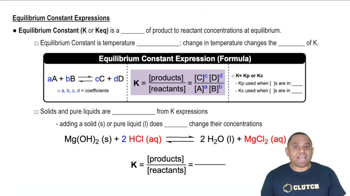
Equilibrium Constant (Kp)
The equilibrium constant (Kp) for a gaseous reaction is defined in terms of the partial pressures of the products and reactants at equilibrium. For the decomposition of BaCO3, Kp can be expressed as the ratio of the partial pressure of CO2 to the concentration of BaCO3 and BaO, allowing for the calculation of the equilibrium pressure of CO2 at a given temperature.
추천 영상:
가이드 코스
Equilibrium Constant Expressions
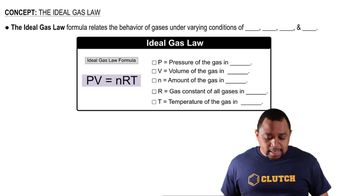
Ideal Gas Law
The Ideal Gas Law (PV=nRT) relates the pressure, volume, temperature, and number of moles of a gas. In this scenario, it can be used to determine the pressure of CO2 at equilibrium by rearranging the equation to solve for pressure (P) when the number of moles and temperature are known, providing a practical approach to finding the equilibrium pressure in the reaction.
추천 영상:
가이드 코스
Ideal Gas Law Formula
관련 실천
교과서 질문
666
views
교과서 질문
Consider the reaction 3 CH4(g) → C3H8(g) + 2 H2(g). (b) Calculate ΔG at 298 K if the reaction mixture consists of 40.0 atm of CH4, 0.0100 atm of C3H8(g), and 0.0180 atm of H2.
685
views
교과서 질문
The value of Ka for nitrous acid (HNO2) at 25 °C is given in Appendix D. (a) Write the chemical equation for the equilibrium that corresponds to Ka.
573
views
교과서 질문
Using data from Appendix C, write the equilibrium-constant expression and calculate the value of the equilibrium constant and the free-energy change for these reactions at 298 K: (a) NaHCO3(s) ⇌ NaOH(s) + CO2(g)
1056
views
교과서 질문
Consider the reaction PbCO3(s) ⇌ PbO(s) + CO2(g) Using data in Appendix C, calculate the equilibrium pressure of CO2 in the system at (a) 400 °C (b) 180 °C.
1209
views
1
rank