Ch.19 - Chemical Thermodynamics
Brown - Chemistry: The Central Science 14th Edition
Brown14th EditionChemistry: The Central ScienceISBN: 9780134414232당신이 사용하는 게 아니라요?교과서 변경
19장, 문제 82

Consider the reaction PbCO3(s) ⇌ PbO(s) + CO2(g) Using data in Appendix C, calculate the equilibrium pressure of CO2 in the system at (a) 400 °C (b) 180 °C.

검증된 단계별 안내
1
Identify the relevant thermodynamic data for each compound involved in the reaction from Appendix C. This includes the standard enthalpy of formation (ΔH°f) and the standard entropy (S°) for PbCO3(s), PbO(s), and CO2(g).
Calculate the standard reaction enthalpy (ΔH°rxn) using the formula: ΔH°rxn = ΣΔH°f(products) - ΣΔH°f(reactants).
Calculate the standard reaction entropy (ΔS°rxn) using the formula: ΔS°rxn = ΣS°(products) - ΣS°(reactants).
Use the Gibbs free energy equation ΔG°rxn = ΔH°rxn - TΔS°rxn to calculate the standard Gibbs free energy change for the reaction at 400 °C (673 K).
Calculate the equilibrium pressure of CO2 using the relation ΔG°rxn = -RT ln(P), where R is the gas constant and P is the equilibrium pressure of CO2. Solve for P to find the equilibrium pressure.

비슷한 문제에 대한 검증된 영상 답변:

이 영상 해법은 위 문제에 도움이 된다고 튜터들이 추천한 것입니다.
영상 길이:
5m
도움이 되었나요?

주요 개념

질문에 올바르게 답하기 위해 반드시 이해해야 하는 핵심 개념들은 다음과 같습니다.

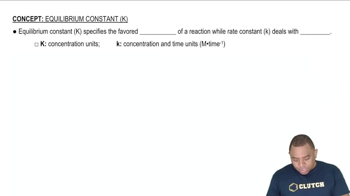
Equilibrium Constant (K)

The equilibrium constant (K) is a numerical value that expresses the ratio of the concentrations of products to reactants at equilibrium for a given reaction at a specific temperature. For the reaction PbCO3(s) ⇌ PbO(s) + CO2(g), K can be determined using the partial pressures of the gaseous products and the concentrations of the solid reactants, which do not appear in the expression. Understanding K is essential for calculating the equilibrium pressure of CO2.
추천 영상:
가이드 코스
01:14
Equilibrium Constant K

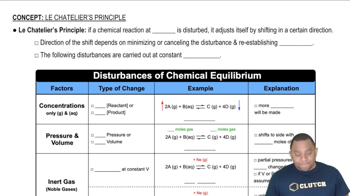
Le Chatelier's Principle

Le Chatelier's Principle states that if a dynamic equilibrium is disturbed by changing the conditions, the system will adjust to counteract the change and restore a new equilibrium. In the context of the given reaction, increasing temperature or pressure can shift the equilibrium position, affecting the concentration of CO2. This principle helps predict how changes in conditions will influence the equilibrium state.
추천 영상:
가이드 코스
07:32
Le Chatelier's Principle

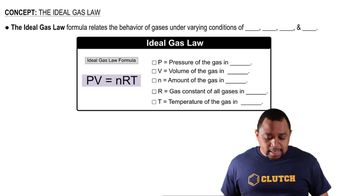
Ideal Gas Law

The Ideal Gas Law (PV=nRT) relates the pressure, volume, temperature, and number of moles of a gas. In this reaction, the pressure of CO2 can be calculated using this law, where P is the pressure we want to find, V is the volume of the system, n is the number of moles of CO2, R is the ideal gas constant, and T is the temperature in Kelvin. This law is crucial for converting the equilibrium constant into a pressure value for the gaseous product.
추천 영상:
가이드 코스
01:15
Ideal Gas Law Formula