
Ch.19 - Chemical Thermodynamics
Brown - Chemistry: The Central Science 14th Edition
Brown14th EditionChemistry: The Central ScienceISBN: 9780134414232당신이 사용하는 게 아니라요?교과서 변경
19장, 문제 115

Hydrogen gas has the potential for use as a clean fuel in reaction with oxygen. The relevant reaction is 2 H21g2 + O21g2 ¡ 2 H2O1l2 Consider two possible ways of utilizing this reaction as an electrical energy source: (i) Hydrogen and oxygen gases are combusted and used to drive a generator, much as coal is currently used in the electric power industry; (ii) hydrogen and oxygen gases are used to generate electricity directly by using fuel cells that operate at 85 °C. (a) Use data in Appendix C to calculate ∆H° and ∆S° for the reaction. We will assume that these values do not change appreciably with temperature.

검증된 단계별 안내
1
Identify the balanced chemical equation for the reaction: \(2 \text{H}_2(g) + \text{O}_2(g) \rightarrow 2 \text{H}_2\text{O}(l)\).
Use Appendix C to find the standard enthalpies of formation (\(\Delta H_f^\circ\)) for each substance involved in the reaction: \(\text{H}_2(g)\), \(\text{O}_2(g)\), and \(\text{H}_2\text{O}(l)\).
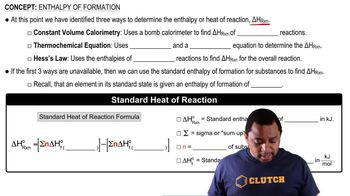
Calculate the standard enthalpy change (\(\Delta H^\circ\)) for the reaction using the formula: \(\Delta H^\circ = \sum \Delta H_f^\circ(\text{products}) - \sum \Delta H_f^\circ(\text{reactants})\).
Use Appendix C to find the standard molar entropies (\(S^\circ\)) for each substance involved in the reaction: \(\text{H}_2(g)\), \(\text{O}_2(g)\), and \(\text{H}_2\text{O}(l)\).
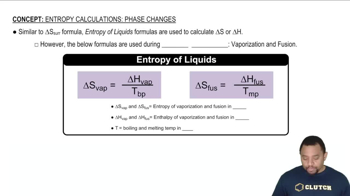
Calculate the standard entropy change (\(\Delta S^\circ\)) for the reaction using the formula: \(\Delta S^\circ = \sum S^\circ(\text{products}) - \sum S^\circ(\text{reactants})\).

비슷한 문제에 대한 검증된 영상 답변:

이 영상 해법은 위 문제에 도움이 된다고 튜터들이 추천한 것입니다.
영상 길이:
4m

주요 개념

질문에 올바르게 답하기 위해 반드시 이해해야 하는 핵심 개념들은 다음과 같습니다.

Enthalpy Change (∆H°)

Enthalpy change (∆H°) is a measure of the heat content of a system at constant pressure. It indicates whether a reaction is exothermic (releases heat, ∆H° < 0) or endothermic (absorbs heat, ∆H° > 0). In the context of the combustion of hydrogen, calculating ∆H° helps determine the energy released when hydrogen reacts with oxygen to form water.
추천 영상:
가이드 코스
02:34
Enthalpy of Formation

Entropy Change (∆S°)

Entropy change (∆S°) quantifies the degree of disorder or randomness in a system. A positive ∆S° indicates an increase in disorder, while a negative ∆S° suggests a decrease. For the reaction of hydrogen and oxygen forming water, understanding ∆S° is crucial for assessing the spontaneity of the reaction and its feasibility as an energy source.
추천 영상:
가이드 코스
01:46
Entropy in Phase Changes

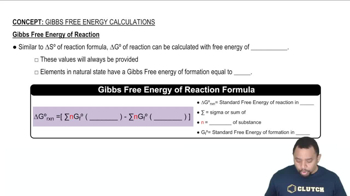
Gibbs Free Energy (∆G°)

Gibbs free energy (∆G°) combines enthalpy and entropy to determine the spontaneity of a reaction at constant temperature and pressure. It is calculated using the equation ∆G° = ∆H° - T∆S°, where T is the temperature in Kelvin. A negative ∆G° indicates that the reaction can occur spontaneously, which is essential for evaluating the efficiency of hydrogen as a clean fuel source.
추천 영상:
가이드 코스
01:51
Gibbs Free Energy of Reactions