
The reaction SO2(g) + 2 H2S(g) ⇌ 3 S(s) + 2 H2O(g) is the basis of a suggested method for removal of SO2 from power-plant stack gases. The standard free energy of each substance is given in Appendix C. (a) What is the equilibrium constant for the reaction at 298 K? (c) If PSO2 = PH2S and the vapor pressure of water is 25 torr, calculate the equilibrium SO2 pressure in the system at 298 K.
Ch.19 - Chemical Thermodynamics
19장, 문제 111b
The reaction SO2(g) + 2 H2S(g) ⇌ 3 S(s) + 2 H2O(g) is the basis of a suggested method for removal of SO2 from power-plant stack gases. The standard free energy of each substance is given in Appendix C. (b) In principle, is this reaction a feasible method of removing SO2?
검증된 단계별 안내1
Identify the standard free energy of formation (\( \Delta G^\circ_f \)) for each substance involved in the reaction from Appendix C.
Write the balanced chemical equation: \( \text{SO}_2(g) + 2 \text{H}_2\text{S}(g) \rightleftharpoons 3 \text{S}(s) + 2 \text{H}_2\text{O}(g) \).
Calculate the standard free energy change (\( \Delta G^\circ \)) for the reaction using the formula: \( \Delta G^\circ = \sum \Delta G^\circ_f(\text{products}) - \sum \Delta G^\circ_f(\text{reactants}) \).
Determine the sign of \( \Delta G^\circ \). If \( \Delta G^\circ < 0 \), the reaction is spontaneous under standard conditions, suggesting feasibility.
Discuss the implications of the \( \Delta G^\circ \) value in terms of the reaction's feasibility for removing \( \text{SO}_2 \) from power-plant stack gases.

비슷한 문제에 대한 검증된 영상 답변:
이 영상 해법은 위 문제에 도움이 된다고 튜터들이 추천한 것입니다.
영상 길이:
4m주요 개념
질문에 올바르게 답하기 위해 반드시 이해해야 하는 핵심 개념들은 다음과 같습니다.
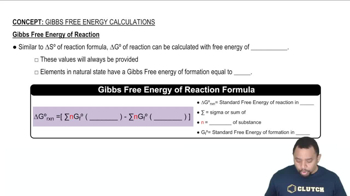
Gibbs Free Energy
Gibbs Free Energy (G) is a thermodynamic potential that measures the maximum reversible work obtainable from a thermodynamic system at constant temperature and pressure. A negative change in Gibbs Free Energy (ΔG) indicates that a reaction is spontaneous and can occur without external energy input. Understanding ΔG is crucial for assessing the feasibility of chemical reactions, such as the removal of SO₂ in this context.
추천 영상:
가이드 코스
Gibbs Free Energy of Reactions
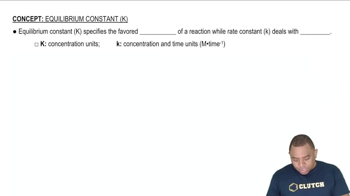
Equilibrium Constant
The equilibrium constant (K) quantifies the ratio of the concentrations of products to reactants at equilibrium for a reversible reaction. It provides insight into the position of equilibrium and the extent to which a reaction proceeds. For the reaction in question, analyzing K can help determine whether the formation of products (S and H₂O) is favored over the reactants (SO₂ and H₂S), indicating the feasibility of SO₂ removal.
추천 영상:
가이드 코스
Equilibrium Constant K
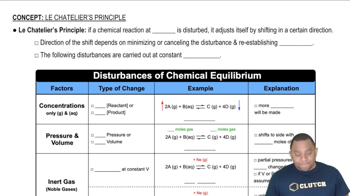
Le Chatelier's Principle
Le Chatelier's Principle states that if a dynamic equilibrium is disturbed by changing the conditions, the system will adjust to counteract the change and restore a new equilibrium. This principle is essential for understanding how changes in concentration, pressure, or temperature can affect the reaction's direction and feasibility, particularly in the context of removing SO₂ from stack gases.
추천 영상:
가이드 코스
Le Chatelier's Principle
관련 실천
교과서 질문
488
views
교과서 질문
Consider the following equilibrium: N2O4(g) ⇌ 2 NO2(g) Thermodynamic data on these gases are given in Appendix C. You may assume that ΔH° and ΔS° do not vary with temperature. (a) At what temperature will an equilibrium mixture contain equal amounts of the two gases?
1162
views
1
rank
교과서 질문
The reaction SO2(g) + 2 H2S(g) ⇌ 3 S(s) + 2 H2O(g) is the basis of a suggested method for removal of SO2 from power-plant stack gases. The standard free energy of each substance is given in Appendix C. (d) Would you expect the process to be more or less effective at higher temperatures?
339
views
교과서 질문
The following data compare the standard enthalpies and free energies of formation of some crystalline ionic substances and aqueous solutions of the substances:
