Ch.19 - Chemical Thermodynamics
Brown - Chemistry: The Central Science 14th Edition
Brown14th EditionChemistry: The Central ScienceISBN: 9780134414232당신이 사용하는 게 아니라요?교과서 변경
19장, 문제 75

Indicate whether ΔG increases, decreases, or stays the same for each of the following reactions as the partial pressure of O2 is increased: (a) 2 CO(g) + O2(g) → 2 CO2(g) (b) 2 H2O2(l) → 2 H2O(l) + O2(g) (c) 2 KClO3(s) → 2 KCl(s) + 3 O2(g)

검증된 단계별 안내
1
Step 1: Understand the relationship between Gibbs free energy change (ΔG) and reaction quotient (Q). The equation ΔG = ΔG° + RT ln(Q) shows that ΔG depends on the reaction quotient Q, which is affected by the partial pressures of gases involved in the reaction.
Step 2: For reaction (a) 2 CO(g) + O₂(g) → 2 CO₂(g), increasing the partial pressure of O₂ will decrease Q because O₂ is a reactant. Since Q decreases, ln(Q) becomes more negative, which decreases ΔG, making the reaction more spontaneous.
Step 3: For reaction (b) 2 H₂O₂(l) → 2 H₂O(l) + O₂(g), increasing the partial pressure of O₂ will increase Q because O₂ is a product. Since Q increases, ln(Q) becomes more positive, which increases ΔG, making the reaction less spontaneous.
Step 4: For reaction (c) 2 KClO₃(s) → 2 KCl(s) + 3 O₂(g), increasing the partial pressure of O₂ will increase Q because O₂ is a product. Since Q increases, ln(Q) becomes more positive, which increases ΔG, making the reaction less spontaneous.
Step 5: Summarize the effects: (a) ΔG decreases, (b) ΔG increases, (c) ΔG increases, as the partial pressure of O₂ is increased.

주요 개념

질문에 올바르게 답하기 위해 반드시 이해해야 하는 핵심 개념들은 다음과 같습니다.

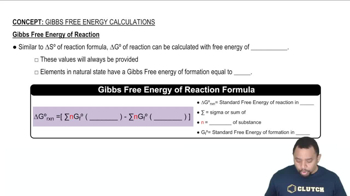
Gibbs Free Energy (ΔG)

Gibbs Free Energy (ΔG) is a thermodynamic potential that measures the maximum reversible work obtainable from a thermodynamic system at constant temperature and pressure. It indicates the spontaneity of a reaction: a negative ΔG suggests a spontaneous process, while a positive ΔG indicates non-spontaneity. Understanding how ΔG changes with varying conditions, such as concentration or pressure, is crucial for predicting reaction behavior.
추천 영상:
가이드 코스
01:51
Gibbs Free Energy of Reactions

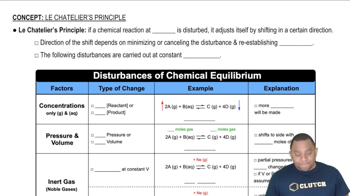
Le Chatelier's Principle

Le Chatelier's Principle states that if a dynamic equilibrium is disturbed by changing the conditions, the position of equilibrium shifts to counteract the change. In the context of gas reactions, increasing the partial pressure of a reactant (like O2) will shift the equilibrium towards the products if the reaction produces fewer moles of gas, thereby affecting the ΔG of the reaction.
추천 영상:
가이드 코스
07:32
Le Chatelier's Principle

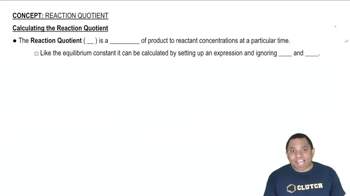
Reaction Quotient (Q) and Equilibrium Constant (K)

The Reaction Quotient (Q) is a measure of the relative concentrations of products and reactants at any point in a reaction, while the Equilibrium Constant (K) describes the ratio at equilibrium. Changes in partial pressures can alter Q, and when Q is compared to K, it helps determine the direction in which the reaction will shift, thus influencing ΔG. Understanding these concepts is essential for analyzing how changes in conditions affect reaction spontaneity.
추천 영상:
가이드 코스
00:49
Reaction Quotient Q