
Ch.19 - Chemical Thermodynamics
Brown - Chemistry: The Central Science 14th Edition
Brown14th EditionChemistry: The Central ScienceISBN: 9780134414232당신이 사용하는 게 아니라요?교과서 변경
19장, 문제 62a

Sulfur dioxide reacts with strontium oxide as follows: SO2(g) + SrO(g) → SrSO3(s) (a) Without using thermochemical data, predict whether ΔG° for this reaction is more negative or less negative than ΔH°.

검증된 단계별 안내
1
Identify the type of reaction: The reaction between sulfur dioxide (SO_2) and strontium oxide (SrO) to form strontium sulfite (SrSO_3) is a combination reaction, where two reactants form a single product.
Consider the entropy change (ΔS°): In this reaction, two gaseous molecules (SO_2 and SrO) combine to form a solid (SrSO_3). This results in a decrease in entropy because gases have higher entropy than solids.
Relate ΔG° and ΔH° using the Gibbs free energy equation: ΔG° = ΔH° - TΔS°. Since ΔS° is negative (entropy decreases), the term -TΔS° becomes positive, which affects the relationship between ΔG° and ΔH°.
Predict the sign of ΔG° relative to ΔH°: Since -TΔS° is positive, ΔG° will be less negative than ΔH° if ΔH° is negative (exothermic reaction). If ΔH° is positive (endothermic reaction), ΔG° could be more positive or less negative than ΔH° depending on the magnitude of TΔS°.
Conclude the prediction: Without specific thermochemical data, the decrease in entropy suggests that ΔG° is likely less negative than ΔH° for this reaction, assuming it is exothermic.

비슷한 문제에 대한 검증된 영상 답변:

이 영상 해법은 위 문제에 도움이 된다고 튜터들이 추천한 것입니다.
영상 길이:
1m

주요 개념

질문에 올바르게 답하기 위해 반드시 이해해야 하는 핵심 개념들은 다음과 같습니다.

Gibbs Free Energy (ΔG)

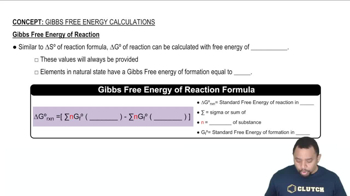
Gibbs Free Energy (ΔG) is a thermodynamic potential that measures the maximum reversible work obtainable from a thermodynamic system at constant temperature and pressure. It combines the system's enthalpy (ΔH) and entropy (ΔS) to determine spontaneity. A negative ΔG indicates a spontaneous reaction, while a positive ΔG suggests non-spontaneity.
추천 영상:
가이드 코스
01:51
Gibbs Free Energy of Reactions

Enthalpy (ΔH)

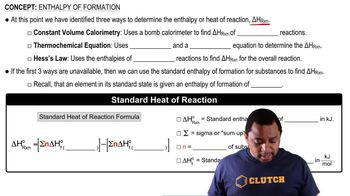
Enthalpy (ΔH) is a measure of the total heat content of a system, reflecting the energy required to create the system and the energy associated with the pressure and volume of the system. In chemical reactions, ΔH can be either positive (endothermic) or negative (exothermic), influencing the overall energy change during the reaction. Understanding ΔH is crucial for predicting reaction behavior.
추천 영상:
가이드 코스
02:34
Enthalpy of Formation

Entropy (ΔS)

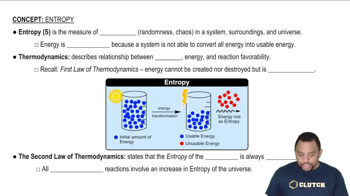
Entropy (ΔS) is a measure of the disorder or randomness in a system. In chemical reactions, an increase in entropy typically favors spontaneity, as systems tend to evolve towards greater disorder. The relationship between ΔG, ΔH, and ΔS is given by the equation ΔG = ΔH - TΔS, where T is the temperature in Kelvin, highlighting how entropy influences the Gibbs Free Energy.
추천 영상:
가이드 코스
02:46
Entropy in Thermodynamics
관련 실천
교과서 질문

Classify each of the following reactions as one of the four possible types summarized in Table 19.3: (i) spontanous at all temperatures; (ii) not spontaneous at any temperature; (iii) spontaneous at low T but not spontaneous at high T; (iv) spontaneous at high T but not spontaneous at low T.

(a) N2(g) + 3 F2(g) → 2 NF3(g) ΔH° = -249 kJ; ΔS° = -278 J/K

(b) N2(g) + 3 Cl2(g) → 2 NCl3(g) ΔH° = 460 kJ; ΔS° = -275 J/K

교과서 질문

Using data from Appendix C, calculate the change in Gibbs free energy for each of the following reactions. In each case, indicate whether the reaction is spontaneous at 298 K under standard conditions.

(a) 2 Ag(s) + Cl2(g) → 2 AgCl(s)

(b) P4O10(s) + 16 H2(g) → 4 PH3(g) + 10 H2O(g)

(c) CH4(g) + 4 F2(g) → CF4(g) + 4 HF(g)

(d) 2 H2O2(l) → 2 H2O(l) + O2(g)

교과서 질문

Classify each of the following reactions as one of the four possible types summarized in Table 19.3: (i) spontaneous at all temperatures; (ii) not spontaneous at any temperature; (iii) spontaneous at low T but not spontaneous at high T; (iv) spontaneous at high T but not spontaneous at low T.

(c) N2F4(g) ⟶ 2 NF2(g) ΔH° = 85 kJ; ΔS° = 198 J/K

839
views
교과서 질문

From the values given for ΔH° and ΔS°, calculate ΔG° for each of the following reactions at 298 K. If the reaction is not spontaneous under standard conditions at 298 K, at what temperature (if any) would the reaction become spontaneous?

a. 2 PbS(s) + 3 O2(g) → 2 PbO(s) + 2 SO2(g) ΔH° = −844 kJ; ΔS° = −165 J/K

b. 2 POCl3(g) → 2 PCl3(g) + O2(g) ΔH° = 572 kJ; ΔS° = 179 J/K

2787
views
1
rank
1
comments