
Ch.19 - Chemical Thermodynamics
Brown - Chemistry: The Central Science 14th Edition
Brown14th EditionChemistry: The Central ScienceISBN: 9780134414232당신이 사용하는 게 아니라요?교과서 변경
19장, 문제 86a

The crystalline hydrate Cd(NO3)2⋅4 H2O(s) loses water when placed in a large, closed, dry vessel at room temperature: Cd(NO3)2⋅4 H2O(s) → Cd(NO3)2(s) + 4 H2O(g) This process is spontaneous and ΔH° is positive at room temperature.
(a) What is the sign of ΔS° at room temperature?

검증된 단계별 안내
1
Understand the concept of spontaneity: A spontaneous process is one that occurs naturally under given conditions. For a process to be spontaneous, the change in Gibbs free energy (ΔG) must be negative.
Recall the Gibbs free energy equation: ΔG = ΔH - TΔS, where ΔG is the change in Gibbs free energy, ΔH is the change in enthalpy, T is the temperature, and ΔS is the change in entropy.
Analyze the given information: The process is spontaneous, and ΔH° is positive. For ΔG to be negative (spontaneous process), the term TΔS must be greater than ΔH.
Consider the implications of a positive ΔH°: Since ΔH° is positive, the process absorbs heat, indicating an endothermic reaction. For the process to remain spontaneous, ΔS° must be positive to ensure TΔS is sufficiently large to make ΔG negative.
Conclude the sign of ΔS°: Given that the process is spontaneous and ΔH° is positive, ΔS° must be positive at room temperature to satisfy the condition ΔG = ΔH - TΔS < 0.

비슷한 문제에 대한 검증된 영상 답변:

이 영상 해법은 위 문제에 도움이 된다고 튜터들이 추천한 것입니다.
영상 길이:
5m

주요 개념

질문에 올바르게 답하기 위해 반드시 이해해야 하는 핵심 개념들은 다음과 같습니다.

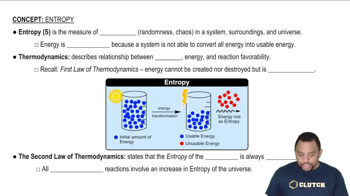
Entropy (ΔS)

Entropy, denoted as ΔS, is a measure of the disorder or randomness in a system. In chemical processes, an increase in entropy typically occurs when a solid or liquid transforms into a gas, as gas molecules have greater freedom of movement and occupy more microstates. Therefore, understanding how the phase change from solid to gas affects the system's disorder is crucial for determining the sign of ΔS.
추천 영상:
가이드 코스
02:46
Entropy in Thermodynamics

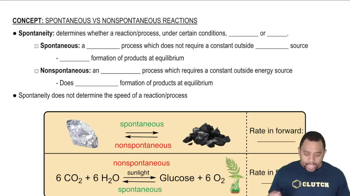
Spontaneity of Reactions

A reaction is considered spontaneous if it occurs without external intervention, often associated with an increase in the total entropy of the system and surroundings. The spontaneity can be predicted using the Gibbs free energy equation, ΔG = ΔH - TΔS. In this case, the process of Cd(NO3)2·4H2O losing water is spontaneous, indicating that the overall change in entropy must be positive despite the positive ΔH.
추천 영상:
가이드 코스
04:20
Spontaneity of Processes

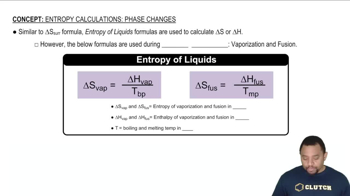
Phase Changes and Energy

Phase changes, such as the transition from solid to gas, involve energy changes that affect both enthalpy (ΔH) and entropy (ΔS). When Cd(NO3)2·4H2O(s) loses water, it undergoes a phase change that increases the number of gaseous water molecules, contributing to a higher entropy. Recognizing how these energy changes relate to the physical states of matter is essential for analyzing the thermodynamic properties of the reaction.
추천 영상:
가이드 코스
01:46
Entropy in Phase Changes