
Ch.19 - Chemical Thermodynamics
Brown - Chemistry: The Central Science 14th Edition
Brown14th EditionChemistry: The Central ScienceISBN: 9780134414232당신이 사용하는 게 아니라요?교과서 변경
19장, 문제 86b

The crystalline hydrate Cd(NO3)2⋅4 H2O(s) loses water when placed in a large, closed, dry vessel at room temperature: Cd(NO3)2⋅4 H2O(s) → Cd(NO3)2(s) + 4 H2O(g) This process is spontaneous and ΔH° is positive at room temperature.
(b) If the hydrated compound is placed in a large, closed vessel that already contains a large amount of water vapor, does ΔS° change for this reaction at room temperature?

검증된 단계별 안내
1
Identify the reaction: The decomposition of the hydrate Cd(NO_3)_2·4H_2O(s) into Cd(NO_3)_2(s) and 4 H_2O(g) is given.
Understand the spontaneity: The process is spontaneous, meaning the overall change in Gibbs free energy (ΔG°) is negative.
Consider the enthalpy change: ΔH° is positive, indicating the reaction is endothermic, absorbing heat from the surroundings.
Analyze the entropy change: Since the reaction involves the conversion of solid hydrate to solid and gaseous water, the entropy (ΔS°) increases due to the increase in disorder from solid to gas.
Evaluate the effect of water vapor: In a vessel with a large amount of water vapor, the increase in entropy (ΔS°) might be less pronounced because the system already has high entropy due to the existing water vapor.

비슷한 문제에 대한 검증된 영상 답변:

이 영상 해법은 위 문제에 도움이 된다고 튜터들이 추천한 것입니다.
영상 길이:
3m

주요 개념

질문에 올바르게 답하기 위해 반드시 이해해야 하는 핵심 개념들은 다음과 같습니다.

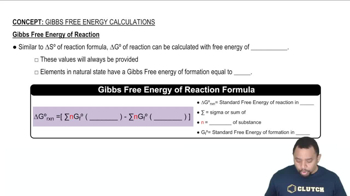
Gibbs Free Energy

Gibbs Free Energy (G) is a thermodynamic potential that helps predict the spontaneity of a process at constant temperature and pressure. The change in Gibbs Free Energy (ΔG) is calculated using the equation ΔG = ΔH - TΔS, where ΔH is the change in enthalpy, T is the temperature in Kelvin, and ΔS is the change in entropy. A negative ΔG indicates a spontaneous process, while a positive ΔG suggests non-spontaneity.
추천 영상:
가이드 코스
01:51
Gibbs Free Energy of Reactions

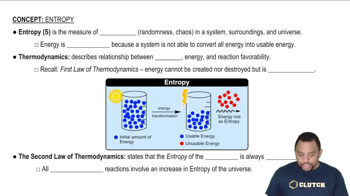
Entropy (ΔS)

Entropy (S) is a measure of the disorder or randomness in a system. The change in entropy (ΔS) during a reaction indicates how the distribution of energy states changes. In the context of the given reaction, the formation of water vapor from a solid hydrate increases the disorder of the system, leading to a positive ΔS, which contributes to the spontaneity of the reaction.
추천 영상:
가이드 코스
02:46
Entropy in Thermodynamics

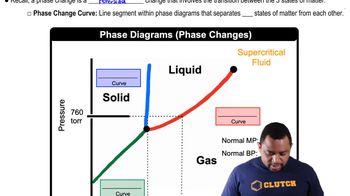
Phase Equilibrium

Phase equilibrium refers to the state in which the phases of a substance (solid, liquid, gas) coexist at equilibrium conditions. In the context of the question, when the hydrated compound is placed in a vessel with existing water vapor, the equilibrium between the solid and gaseous phases may shift. This can affect the overall entropy change (ΔS) of the system, as the presence of water vapor influences the potential for further evaporation or condensation.
추천 영상:
가이드 코스
03:22
Phase Changes in Diagrams