Ch.19 - Chemical Thermodynamics
Brown - Chemistry: The Central Science 14th Edition
Brown14th EditionChemistry: The Central ScienceISBN: 9780134414232당신이 사용하는 게 아니라요?교과서 변경
19장, 문제 16b

The normal freezing point of n-octane (C8H18) is -57 °C. (b) In what temperature range is the freezing of n-octane a spontaneous process?

검증된 단계별 안내
1
insert step 1> Determine the concept of spontaneity in terms of Gibbs free energy (\( \Delta G \)). A process is spontaneous when \( \Delta G < 0 \).
insert step 2> Use the Gibbs free energy equation: \( \Delta G = \Delta H - T\Delta S \), where \( \Delta H \) is the enthalpy change, \( T \) is the temperature in Kelvin, and \( \Delta S \) is the entropy change.
insert step 3> Recognize that at the freezing point, \( \Delta G = 0 \), so \( \Delta H = T_f \Delta S \), where \( T_f \) is the freezing point in Kelvin.
insert step 4> Convert the freezing point from Celsius to Kelvin: \( T_f = -57 + 273.15 \).
insert step 5> Determine the temperature range for spontaneity: For freezing to be spontaneous, the temperature must be below the freezing point, so \( T < T_f \).

비슷한 문제에 대한 검증된 영상 답변:

이 영상 해법은 위 문제에 도움이 된다고 튜터들이 추천한 것입니다.
영상 길이:
1m

주요 개념

질문에 올바르게 답하기 위해 반드시 이해해야 하는 핵심 개념들은 다음과 같습니다.

Freezing Point

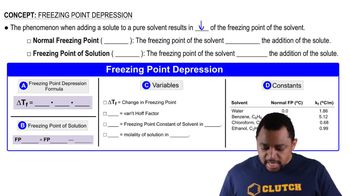
The freezing point of a substance is the temperature at which it transitions from a liquid to a solid state. For n-octane, this point is -57 °C, meaning that at temperatures below this value, n-octane will solidify. Understanding the freezing point is crucial for determining the conditions under which a substance will freeze spontaneously.
추천 영상:
가이드 코스
01:59
Freezing Point Depression

Spontaneity of Processes

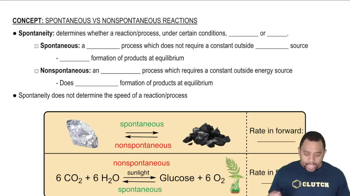
A spontaneous process is one that occurs without needing to be driven by an external force. In thermodynamics, spontaneity is often determined by changes in enthalpy and entropy. For freezing to be spontaneous, the system must favor lower energy states, which typically occurs at temperatures below the freezing point of the substance.
추천 영상:
가이드 코스
04:20
Spontaneity of Processes

Thermodynamic Stability

Thermodynamic stability refers to the tendency of a system to remain in a particular state under given conditions. For n-octane, below its freezing point, the solid state is more stable than the liquid state. This stability is influenced by factors such as temperature and pressure, which dictate whether the freezing process will occur spontaneously.
추천 영상:
가이드 코스
01:18
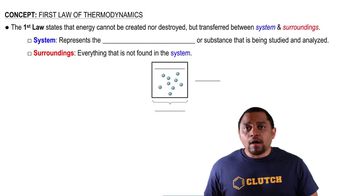
First Law of Thermodynamics