Ch.19 - Chemical Thermodynamics
Brown - Chemistry: The Central Science 14th Edition
Brown14th EditionChemistry: The Central ScienceISBN: 9780134414232당신이 사용하는 게 아니라요?교과서 변경
19장, 문제 16d

The normal freezing point of n-octane (C8H18) is -57 °C. (d) Is there any temperature at which liquid n-octane and solid n-octane are in equilibrium? Explain.

검증된 단계별 안내
1
1. The freezing point of a substance is the temperature at which the liquid and solid phases of the substance are in equilibrium. This means that at this temperature, the rate at which the substance freezes (goes from liquid to solid) is equal to the rate at which it melts (goes from solid to liquid).
2. For n-octane, this temperature is -57 °C. Therefore, at -57 °C, liquid n-octane and solid n-octane are in equilibrium.
3. At temperatures above -57 °C, n-octane will be in the liquid phase because the rate of melting will be greater than the rate of freezing. At temperatures below -57 °C, n-octane will be in the solid phase because the rate of freezing will be greater than the rate of melting.
4. Therefore, there is only one temperature at which liquid n-octane and solid n-octane are in equilibrium, and that is at its freezing point of -57 °C.
5. In conclusion, the freezing point of a substance is the temperature at which the liquid and solid phases of the substance are in equilibrium. For n-octane, this temperature is -57 °C.

비슷한 문제에 대한 검증된 영상 답변:

이 영상 해법은 위 문제에 도움이 된다고 튜터들이 추천한 것입니다.
영상 길이:
2m

주요 개념

질문에 올바르게 답하기 위해 반드시 이해해야 하는 핵심 개념들은 다음과 같습니다.

Phase Equilibrium

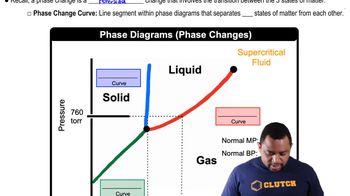
Phase equilibrium occurs when two phases of a substance, such as solid and liquid, coexist at a specific temperature and pressure. At this point, the rates of melting and freezing are equal, leading to a stable condition where both phases are present. For n-octane, this equilibrium can be established at its freezing point, where the solid and liquid forms can exist together.
추천 영상:
가이드 코스
03:22
Phase Changes in Diagrams

Freezing Point

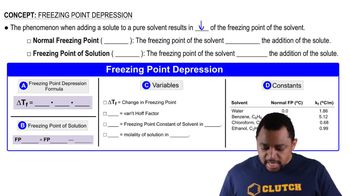
The freezing point is the temperature at which a liquid turns into a solid under a given pressure. For n-octane, the normal freezing point is -57 °C, meaning that at this temperature, n-octane can exist as both a liquid and a solid. Understanding this concept is crucial for determining the conditions under which n-octane can transition between its phases.
추천 영상:
가이드 코스
01:59
Freezing Point Depression

Thermodynamic Stability

Thermodynamic stability refers to the state of a system where it is at its lowest energy configuration, making it resistant to change. In the context of n-octane, the equilibrium between its solid and liquid phases represents a stable state at the freezing point. Any deviation from this temperature will favor either the solid or liquid phase, illustrating the importance of temperature in phase behavior.
추천 영상:
가이드 코스
01:18
First Law of Thermodynamics