Ch.19 - Chemical Thermodynamics
Brown - Chemistry: The Central Science 14th Edition
Brown14th EditionChemistry: The Central ScienceISBN: 9780134414232당신이 사용하는 게 아니라요?교과서 변경
19장, 문제 49

The standard entropies at 298 K for certain group 4A elements are: C(s, diamond) = 2.43 J>mol@K, Si1s2 = 18.81 J>mol@K, Ge1s2 = 31.09 J>mol@K, and Sn1s2 = 51.818 J>mol@K. All but Sn have the same (diamond) structure. How do you account for the trend in the S° values?

검증된 단계별 안내
1
Identify the physical state and structure of each element mentioned: Carbon (diamond), Silicon, Germanium, and Tin all in solid state. Note that Carbon, Silicon, and Germanium have the same diamond crystal structure, while Tin has a different structure.
Understand that standard entropy (S°) is a measure of the randomness or disorder in a system. Elements in the same physical state but with different crystal structures can have different levels of disorder.
Recognize that as you move down the group in the periodic table (from C to Sn), the atomic size and mass increase. This generally leads to an increase in entropy because larger atoms can have more complex vibrations and more disordered arrangements.
Consider the impact of crystal structure on entropy. The diamond structure, shared by C, Si, and Ge, is highly ordered, which tends to lower entropy. Sn, however, does not have this structure, which might contribute to its higher entropy.
Conclude that the trend in the S° values from C to Sn can be explained by both the increasing atomic size and mass, and the change in crystal structure, which contribute to the overall increase in disorder and thus entropy.

비슷한 문제에 대한 검증된 영상 답변:

이 영상 해법은 위 문제에 도움이 된다고 튜터들이 추천한 것입니다.
영상 길이:
1m
도움이 되었나요?

주요 개념

질문에 올바르게 답하기 위해 반드시 이해해야 하는 핵심 개념들은 다음과 같습니다.

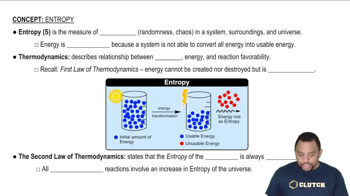
Entropy

Entropy is a measure of the disorder or randomness in a system. In thermodynamics, it quantifies the number of ways a system can be arranged, with higher entropy indicating greater disorder. The standard entropy values provided for the group 4A elements reflect their molecular complexity and structural arrangements, influencing their thermal energy distribution.
추천 영상:
가이드 코스
02:46
Entropy in Thermodynamics

Allotropes

Allotropes are different structural forms of the same element, where atoms are bonded together in different ways. For example, carbon exists as diamond and graphite, each with distinct properties and entropies. The presence of different allotropes, such as diamond for C and the more complex structures for Sn, affects the entropy values due to variations in atomic arrangement and bonding.

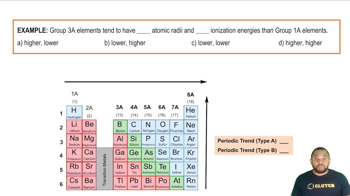
Trends in Group 4A Elements

In group 4A of the periodic table, elements exhibit trends in properties such as atomic size, electronegativity, and entropy. As you move down the group from carbon to tin, the atomic size increases, leading to more complex structures and higher entropy values. This trend is influenced by the increasing number of electrons and the resulting increase in possible microstates, contributing to the observed differences in standard entropy.
추천 영상:
가이드 코스
00:59
Main Group Elements: Periodic Trends Example