
Ch.2 - Atoms, Molecules, and Ions
Brown - Chemistry: The Central Science 14th Edition
Brown14th EditionChemistry: The Central ScienceISBN: 9780134414232당신이 사용하는 게 아니라요?교과서 변경
2장, 문제 16a

An unknown particle is caused to move between two electrically charged plates, as illustrated in Figure 2.7. You hypothesize that the particle is a proton. (a) If your hypothesis is correct, would the particle be deflected in the same or opposite direction as the b rays?
Diagram showing a radioactive substance emitting particles between charged plates, illustrating particle deflection.

검증된 단계별 안내
1
Identify the charge of the proton. A proton has a positive charge.
Observe the deflection of the β rays in the diagram. β rays (beta particles) are negatively charged and are deflected towards the positive plate.
Determine the direction of deflection for a positively charged particle. Since opposite charges attract, a positively charged particle like a proton would be deflected towards the negative plate.
Compare the deflection direction of the proton with that of the β rays. The β rays are deflected towards the positive plate, while the proton would be deflected towards the negative plate.
Conclude whether the proton would be deflected in the same or opposite direction as the β rays. Since the proton is deflected towards the negative plate and the β rays towards the positive plate, the proton would be deflected in the opposite direction to the β rays.

비슷한 문제에 대한 검증된 영상 답변:

이 영상 해법은 위 문제에 도움이 된다고 튜터들이 추천한 것입니다.
영상 길이:
1m
도움이 되었나요?

주요 개념

질문에 올바르게 답하기 위해 반드시 이해해야 하는 핵심 개념들은 다음과 같습니다.

Electric Charge and Forces

Electric charge is a fundamental property of particles that causes them to experience a force when placed in an electric field. Charged plates create an electric field between them, which exerts a force on charged particles, causing them to accelerate. The direction of the force depends on the sign of the charge; positive charges are attracted to negative plates and repelled by positive plates.
추천 영상:

Particle Types in Radiation

In nuclear physics, particles emitted from radioactive substances include alpha (α), beta (β), and gamma (γ) rays. Alpha particles are positively charged helium nuclei, beta particles are high-energy electrons or positrons, and gamma rays are high-energy electromagnetic radiation with no charge. Understanding the charge and mass of these particles is crucial for predicting their behavior in electric fields.
추천 영상:
가이드 코스
05:19
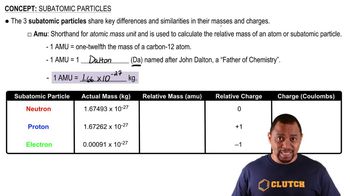
Subatomic Particles

Deflection of Charged Particles

When charged particles move through an electric field, they experience a deflection based on their charge and the direction of the field. A positively charged particle, like a proton, will be deflected toward the negatively charged plate, while negatively charged particles will move toward the positively charged plate. This principle is essential for determining the trajectory of particles in experiments involving electric fields.
추천 영상:
가이드 코스
05:19
Subatomic Particles
관련 실천
교과서 질문

In a series of experiments, a chemist prepared three different compounds that contain only iodine and fluorine and determined the mass of each element in each compound: Compound Mass of Iodine (g) Mass of Fluorine (g) 1 4.75 3.56 2 7.64 3.43 3 9.41 9.86 (b) How do the numbers in part (a) support the atomic theory?

649
views
1
rank
교과서 질문

Millikan determined the charge on the electron by studying the static charges on oil drops falling in an electric field (Figure 2.5). A student carried out this experiment using several oil drops for her measurements and calculated the charges on the drops. She obtained the following data: Droplet Calculated Charge (C) A 1.60 * 10-19 B 3.15 * 10-19 C 4.81 * 10-19 D 6.31 * 10-19 (b) What conclusion can the student draw from these data regarding the charge of the electron?

1377
views
교과서 질문
Discovering which of the three subatomic particles proved to be the most difficult—the proton, neutron, or electron? Why?
372
views
교과서 질문

In a series of experiments, a chemist prepared three different compounds that contain only iodine and fluorine and determined the mass of each element in each compound: Compound Mass of Iodine (g) Mass of Fluorine (g) 1 4.75 3.56 2 7.64 3.43 3 9.41 9.86 (a) Calculate the mass of fluorine per gram of iodine in Compound 3.

742
views
교과서 질문

An unknown particle is caused to move between two electrically charged plates, as illustrated in Figure 2.7. You hypothesize that the particle is a proton. (b) Would it be deflected by a smaller or larger amount than the b rays?

515
views
교과서 질문
What fraction of the a particles in Rutherford's gold foil experiment are scattered at large angles? Assume the gold foil is two layers thick, as shown in Figure 2.9, and that the approximate diameters of a gold atom and its nucleus are 270 pm and 1.0 * 10–2 pm, respectively. Hint: Calculate the cross sectional area occupied by the nucleus as a fraction of that occupied by the atom. Assume that the gold nuclei in each layer are offset from each other.
1545
views
2
rank