
Ch.2 - Atoms, Molecules, and Ions
Brown - Chemistry: The Central Science 14th Edition
Brown14th EditionChemistry: The Central ScienceISBN: 9780134414232당신이 사용하는 게 아니라요?교과서 변경
2장, 문제 15

Discovering which of the three subatomic particles proved to be the most difficult—the proton, neutron, or electron? Why?

검증된 단계별 안내
1
1. The question is asking about the historical discovery of subatomic particles, specifically the proton, neutron, and electron. It's important to note that the difficulty of discovering these particles is not a chemistry concept, but rather a historical fact.
2. The electron was the first subatomic particle to be discovered. J.J. Thomson discovered the electron in 1897 through his cathode ray experiments. He found that cathode rays were composed of negatively charged particles, which he called 'corpuscles', but are now known as electrons.
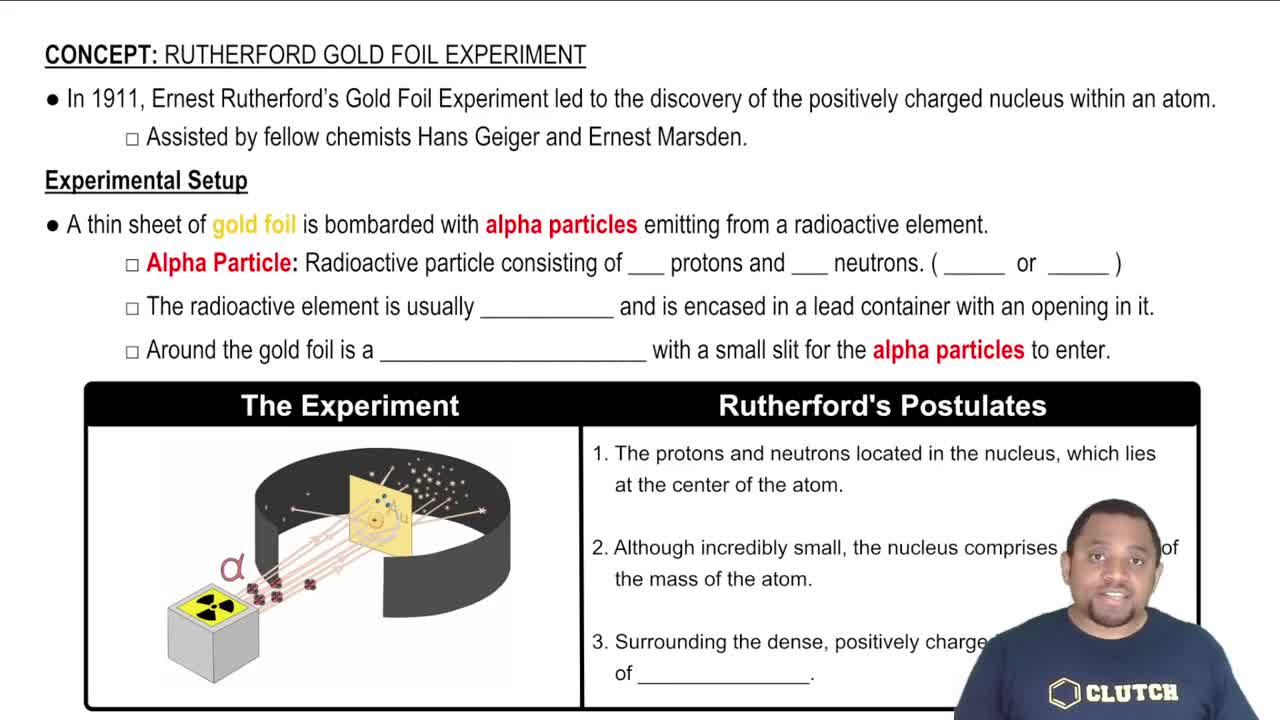
3. The proton was discovered next. In 1911, Ernest Rutherford discovered the nucleus of the atom, and by 1919, he had identified the proton as a particle within the nucleus. He did this through his gold foil experiment, where he found that some alpha particles were deflected at large angles, indicating a small, dense, positively charged nucleus.
4. The neutron was the last of the three to be discovered, and proved to be the most difficult. This is because neutrons are uncharged particles, making them harder to detect. James Chadwick finally discovered the neutron in 1932, after years of experiments and theoretical work.
5. In summary, the neutron was the most difficult subatomic particle to discover due to its lack of charge, which made it harder to detect and identify compared to the charged proton and electron.

비슷한 문제에 대한 검증된 영상 답변:

이 영상 해법은 위 문제에 도움이 된다고 튜터들이 추천한 것입니다.
영상 길이:
9m
도움이 되었나요?

주요 개념

질문에 올바르게 답하기 위해 반드시 이해해야 하는 핵심 개념들은 다음과 같습니다.

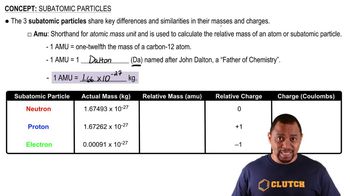
Subatomic Particles

Subatomic particles are the fundamental constituents of atoms, primarily including protons, neutrons, and electrons. Protons are positively charged and reside in the nucleus, neutrons are neutral and also found in the nucleus, while electrons are negatively charged and orbit the nucleus. Understanding their properties and interactions is crucial for grasping atomic structure and behavior.
추천 영상:
가이드 코스
05:19
Subatomic Particles

Historical Context of Discovery

The discovery of subatomic particles occurred over time, with significant contributions from various scientists. The electron was the first to be identified by J.J. Thomson in 1897, followed by the proton and neutron, discovered by Ernest Rutherford and James Chadwick, respectively. The challenges faced in detecting these particles were influenced by their properties, such as mass and charge, which affected experimental techniques.
추천 영상:
가이드 코스
02:43
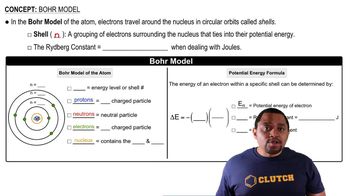
Bohr Model of the Atom

Detection Techniques

Different detection techniques were employed to identify subatomic particles, each with varying degrees of difficulty. For instance, electrons could be detected using cathode rays, while protons and neutrons required more complex methods like scattering experiments. The mass and charge of these particles influenced the effectiveness of these techniques, making the neutron particularly challenging to detect due to its lack of charge.
추천 영상:
가이드 코스
04:22
Rutherford Gold Foil Experiment
관련 실천
교과서 질문

In a series of experiments, a chemist prepared three different compounds that contain only iodine and fluorine and determined the mass of each element in each compound: Compound Mass of Iodine (g) Mass of Fluorine (g) 1 4.75 3.56 2 7.64 3.43 3 9.41 9.86 (b) How do the numbers in part (a) support the atomic theory?

649
views
1
rank
교과서 질문

In a series of experiments, a chemist prepared three different compounds that contain only iodine and fluorine and determined the mass of each element in each compound: Compound Mass of Iodine (g) Mass of Fluorine (g) 1 4.75 3.56 2 7.64 3.43 3 9.41 9.86 (a) Calculate the mass of fluorine per gram of iodine in Compound 3.

742
views
교과서 질문

An unknown particle is caused to move between two electrically charged plates, as illustrated in Figure 2.7. You hypothesize that the particle is a proton. (b) Would it be deflected by a smaller or larger amount than the b rays?

515
views
교과서 질문

An unknown particle is caused to move between two electrically charged plates, as illustrated in Figure 2.7. You hypothesize that the particle is a proton. (a) If your hypothesis is correct, would the particle be deflected in the same or opposite direction as the b rays?

823
views
교과서 질문

In a series of experiments, a chemist prepared three different compounds that contain only iodine and fluorine and determined the mass of each element in each compound: Compound Mass of Iodine (g) Mass of Fluorine (g) 1 4.75 3.56 2 7.64 3.43 3 9.41 9.86 (a) Calculate the mass of fluorine per gram of iodine in Compound 1 and 2.

882
views
교과서 질문
What fraction of the a particles in Rutherford's gold foil experiment are scattered at large angles? Assume the gold foil is two layers thick, as shown in Figure 2.9, and that the approximate diameters of a gold atom and its nucleus are 270 pm and 1.0 * 10–2 pm, respectively. Hint: Calculate the cross sectional area occupied by the nucleus as a fraction of that occupied by the atom. Assume that the gold nuclei in each layer are offset from each other.
1545
views
2
rank