
Ch.2 - Atoms, Molecules, and Ions
Brown - Chemistry: The Central Science 14th Edition
Brown14th EditionChemistry: The Central ScienceISBN: 9780134414232당신이 사용하는 게 아니라요?교과서 변경
2장, 문제 113e,f,g,h

Because many ions and compounds have very similar names, there is great potential for confusing them. Write the correct chemical formulas to distinguish between (e) hydride ion and hydroxide ion, (f) magnesium nitride and magnesium nitrite, (g) mercurous chloride and mercuric chloride, (h) cuprous oxide and cupric oxide.

검증된 단계별 안내
1
Understand the difference between mercurous and mercuric ions: Mercurous refers to mercury(I) with a +1 oxidation state, while mercuric refers to mercury(II) with a +2 oxidation state.
Identify the chemical symbol for mercury, which is Hg.
For mercurous chloride, recognize that it involves the mercury(I) ion, which is represented as Hg2^2+. This is because two mercury atoms share a +2 charge, effectively making each mercury atom have a +1 charge.
Combine the mercurous ion with chloride (Cl^-), which has a -1 charge. The formula for mercurous chloride is Hg2Cl2, as two chloride ions are needed to balance the +2 charge of the Hg2^2+ ion.
For mercuric chloride, use the mercury(II) ion, represented as Hg^2+. Combine this with chloride (Cl^-), which has a -1 charge. The formula for mercuric chloride is HgCl2, as two chloride ions are needed to balance the +2 charge of the Hg^2+ ion.

비슷한 문제에 대한 검증된 영상 답변:

이 영상 해법은 위 문제에 도움이 된다고 튜터들이 추천한 것입니다.
영상 길이:
1m
도움이 되었나요?

주요 개념

질문에 올바르게 답하기 위해 반드시 이해해야 하는 핵심 개념들은 다음과 같습니다.

Ionic Compounds

Ionic compounds are formed from the electrostatic attraction between positively charged cations and negatively charged anions. The chemical formula of an ionic compound reflects the ratio of these ions, ensuring that the overall charge is neutral. Understanding how to write these formulas is crucial for distinguishing between compounds with similar names, such as mercurous and mercuric chloride.
추천 영상:
가이드 코스
02:11
Ionic Compounds Naming

Oxidation States

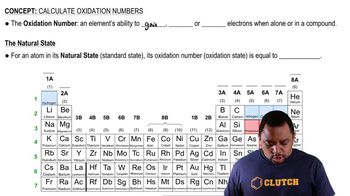
Oxidation states indicate the degree of oxidation of an atom in a compound, which is essential for identifying the specific ions present. In the case of mercury, it can exist in multiple oxidation states, notably +1 and +2. Mercurous chloride (Hg2Cl2) contains mercury in the +1 oxidation state, while mercuric chloride (HgCl2) has mercury in the +2 state, highlighting the importance of oxidation states in naming and formula writing.
추천 영상:
가이드 코스
02:42
Oxidation Numbers

Nomenclature of Transition Metals

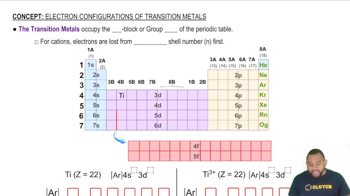
The nomenclature of transition metals involves using Roman numerals to indicate the oxidation state of the metal in a compound. This system helps differentiate between compounds that contain the same elements but differ in their oxidation states. For example, mercurous chloride is named using the +1 oxidation state (mercurous), while mercuric chloride uses the +2 state (mercuric), which is vital for accurately conveying chemical information.
추천 영상:
가이드 코스
03:12
Transition Metals