
Ch.2 - Atoms, Molecules, and Ions
Brown - Chemistry: The Central Science 14th Edition
Brown14th EditionChemistry: The Central ScienceISBN: 9780134414232당신이 사용하는 게 아니라요?교과서 변경
2장, 문제 114

In what part of the atom does the strong nuclear force operate?

검증된 단계별 안내
1
Step 1: Understand the structure of an atom, which consists of a nucleus containing protons and neutrons, surrounded by electrons in orbitals.
Step 2: Recognize that the strong nuclear force is one of the four fundamental forces in nature, responsible for holding the atomic nucleus together.
Step 3: Identify that the strong nuclear force operates within the nucleus of the atom, acting between protons and neutrons.
Step 4: Note that this force is much stronger than the electromagnetic force that would otherwise cause the positively charged protons to repel each other.
Step 5: Conclude that the strong nuclear force is crucial for the stability of the nucleus, overcoming the repulsive forces between protons.

주요 개념

질문에 올바르게 답하기 위해 반드시 이해해야 하는 핵심 개념들은 다음과 같습니다.

Strong Nuclear Force

The strong nuclear force is one of the four fundamental forces of nature, responsible for holding protons and neutrons together in the atomic nucleus. It is a short-range force that operates at distances on the order of one femtometer (10^-15 meters) and is significantly stronger than the electromagnetic force, which causes repulsion between positively charged protons.
추천 영상:
가이드 코스
01:51
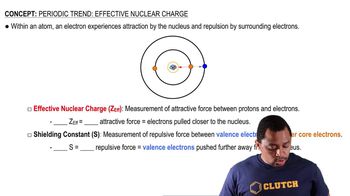
Effective Nuclear Charge

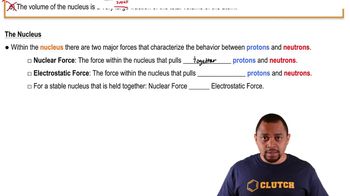
Atomic Nucleus

The atomic nucleus is the dense central core of an atom, composed of protons and neutrons, collectively known as nucleons. The nucleus contains most of the atom's mass and is held together by the strong nuclear force, which overcomes the repulsive electromagnetic force between the positively charged protons.
추천 영상:

Nuclear Interactions

Nuclear interactions refer to the forces and processes that occur within the atomic nucleus, primarily involving the strong nuclear force and weak nuclear force. These interactions govern the stability of the nucleus, nuclear decay, and reactions such as fusion and fission, which are essential for understanding nuclear chemistry and physics.
추천 영상:
가이드 코스
02:06
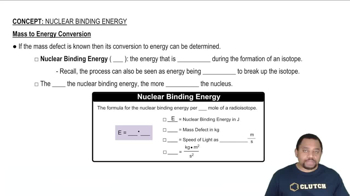
Nuclear Binding Energy