
(a) Thomson's cathode-ray tube (Figure 2.4) and the mass spectrometer (Figure 2.11) both involve the use of electric or magnetic fields to deflect charged particles. What are the charged particles involved in each of these experiments?
Ch.2 - Atoms, Molecules, and Ions
2장, 문제 36
Rubidium has two naturally occurring isotopes, rubidium-85 (atomic mass = 84.9118 amu; abundance = 72.15%) and rubidium-87 (atomic mass = 86.9092 amu; abundance = 27.85%). Calculate the atomic weight of rubidium
검증된 단계별 안내1
Identify the isotopes of rubidium and their respective atomic masses and abundances: Rubidium-85 with an atomic mass of 84.9118 amu and an abundance of 72.15%, and Rubidium-87 with an atomic mass of 86.9092 amu and an abundance of 27.85%.
Convert the percentage abundances into decimal form by dividing each by 100. For Rubidium-85, it becomes 0.7215, and for Rubidium-87, it becomes 0.2785.
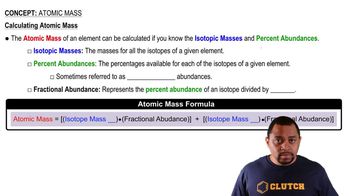
Calculate the contribution of each isotope to the atomic weight by multiplying the atomic mass of each isotope by its decimal abundance. For Rubidium-85, multiply 84.9118 amu by 0.7215. For Rubidium-87, multiply 86.9092 amu by 0.2785.
Add the contributions from each isotope to find the atomic weight of rubidium. This is done by summing the results from the previous step.
The result from the addition gives the atomic weight of rubidium, which is the weighted average of the atomic masses of its isotopes.

비슷한 문제에 대한 검증된 영상 답변:
이 영상 해법은 위 문제에 도움이 된다고 튜터들이 추천한 것입니다.
영상 길이:
3m도움이 되었나요?
주요 개념
질문에 올바르게 답하기 위해 반드시 이해해야 하는 핵심 개념들은 다음과 같습니다.
Isotopes
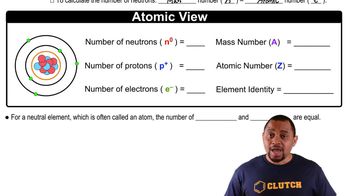
Isotopes are variants of a chemical element that have the same number of protons but different numbers of neutrons, resulting in different atomic masses. For example, rubidium has two isotopes: rubidium-85 and rubidium-87. Understanding isotopes is crucial for calculating the average atomic weight of an element based on the relative abundances of its isotopes.
추천 영상:
가이드 코스
Isotopes
Atomic Weight Calculation
The atomic weight of an element is calculated by taking the weighted average of the atomic masses of its isotopes, considering their relative abundances. This involves multiplying the atomic mass of each isotope by its percentage abundance (expressed as a fraction) and summing these values. This concept is essential for determining the overall atomic weight of rubidium in this question.
추천 영상:
가이드 코스
Calculating Atomic Mass
Percentage Abundance
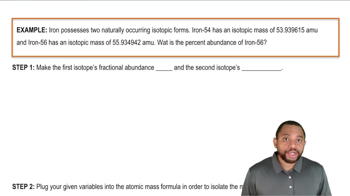
Percentage abundance refers to the proportion of each isotope of an element present in a natural sample, expressed as a percentage. In the case of rubidium, the abundances of rubidium-85 and rubidium-87 are 72.15% and 27.85%, respectively. This information is vital for accurately calculating the atomic weight, as it directly influences the contribution of each isotope to the final average.
추천 영상:
가이드 코스
Calculating Abundance Example
관련 실천
교과서 질문
657
views
1
rank
교과서 질문
(a) What is the mass in u of a carbon-12 atom?
교과서 질문
Consider the mass spectrometer shown in Figure 2.11. Determine whether each of the following statements is true or false. If false, correct the statement to make it true: (a) The paths of neutral (uncharged) atoms are not affected by the magnet.
567
views
교과서 질문
Only two isotopes of copper occur naturally: 63Cu (atomic mass = 62.9296 amu; abundance 69.17%) 65Cu (atomic mass = 64.9278 amu; abundance 30.83%). Calculate the atomic weight (average atomic mass) of copper.
4359
views
교과서 질문
(b) Why is the atomic weight of carbon reported as 12.011 in the table of elements and the periodic table in the front inside cover of this text?
1408
views
