

Ch.2 - Atoms, Molecules, and Ions
Brown - Chemistry: The Central Science 14th Edition
Brown14th EditionChemistry: The Central ScienceISBN: 9780134414232당신이 사용하는 게 아니라요?교과서 변경
2장, 문제 38a

Consider the mass spectrometer shown in Figure 2.11. Determine whether each of the following statements is true or false. If false, correct the statement to make it true: (a) The paths of neutral (uncharged) atoms are not affected by the magnet.

검증된 단계별 안내
1
Understand the basic principle of a mass spectrometer, which is used to separate isotopes, molecules, and molecular fragments according to their mass-to-charge ratio. The key components include an ion source, a mass analyzer, and a detector.
Recognize that in a mass spectrometer, particles must be ionized (charged) so that they can be influenced by magnetic and electric fields. Neutral (uncharged) atoms or molecules do not carry a charge.
Recall that the magnetic field in a mass spectrometer is used to deflect the path of the charged particles. The degree of deflection depends on the mass-to-charge ratio of the particles.
Analyze the statement: Since neutral atoms do not have a charge, they will not experience a force from the magnetic field. Therefore, the magnetic field does not affect the paths of neutral atoms.
Conclude that the statement 'The paths of neutral (uncharged) atoms are not affected by the magnet' is true, as neutral atoms will not be deflected by the magnetic field and will continue in a straight path.

비슷한 문제에 대한 검증된 영상 답변:

이 영상 해법은 위 문제에 도움이 된다고 튜터들이 추천한 것입니다.
영상 길이:
1m
도움이 되었나요?

주요 개념

질문에 올바르게 답하기 위해 반드시 이해해야 하는 핵심 개념들은 다음과 같습니다.

Mass Spectrometry

Mass spectrometry is an analytical technique used to measure the mass-to-charge ratio of ions. It involves ionizing chemical species and sorting the ions based on their mass and charge. This technique is crucial for identifying the composition of a sample and determining the structure of molecules.
추천 영상:

Ionization and Charge

In mass spectrometry, ionization is the process of converting atoms or molecules into ions by adding or removing charged particles. Charged ions are influenced by electric and magnetic fields, while neutral atoms remain unaffected. Understanding the role of charge is essential for interpreting the behavior of particles in a mass spectrometer.
추천 영상:
가이드 코스
01:19
Ionization Energy

Magnetic Fields and Particle Motion

Magnetic fields exert forces on charged particles, causing them to follow curved paths. The direction and radius of the curvature depend on the charge and velocity of the particle, as well as the strength of the magnetic field. Neutral particles, lacking charge, do not experience this force and thus travel in straight lines, which is key to understanding the statement in the question.
추천 영상:
가이드 코스
02:40
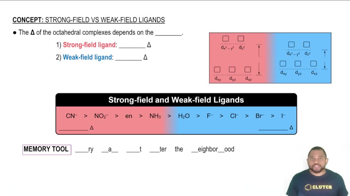
Strong-Field Ligands result in a large Δ and Weak-Field Ligands result in a small Δ.