
Ch.2 - Atoms, Molecules, and Ions
Brown - Chemistry: The Central Science 14th Edition
Brown14th EditionChemistry: The Central ScienceISBN: 9780134414232당신이 사용하는 게 아니라요?교과서 변경
2장, 문제 105

From the molecular structures shown here, identify the one that corresponds to each of the following species: (a) chlorine gas; (b) propane; (c) nitrate ion; (d) sulfur trioxide; (e) methyl chloride, CH3Cl.
Molecular structures of chlorine gas, propane, nitrate ion, sulfur trioxide, and methyl chloride.

검증된 단계별 안내
1
Identify the molecular structure of chlorine gas (Cl2). Chlorine gas consists of two chlorine atoms bonded together.
Identify the molecular structure of propane (C3H8). Propane consists of three carbon atoms bonded in a chain with eight hydrogen atoms attached.
Identify the molecular structure of the nitrate ion (NO3-). The nitrate ion consists of one nitrogen atom bonded to three oxygen atoms, with one of the bonds being a double bond.
Identify the molecular structure of sulfur trioxide (SO3). Sulfur trioxide consists of one sulfur atom bonded to three oxygen atoms, with all bonds being double bonds.
Identify the molecular structure of methyl chloride (CH3Cl). Methyl chloride consists of one carbon atom bonded to three hydrogen atoms and one chlorine atom.

비슷한 문제에 대한 검증된 영상 답변:

이 영상 해법은 위 문제에 도움이 된다고 튜터들이 추천한 것입니다.
영상 길이:
1m
도움이 되었나요?

주요 개념

질문에 올바르게 답하기 위해 반드시 이해해야 하는 핵심 개념들은 다음과 같습니다.

Molecular Structure

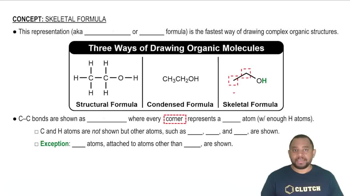
Molecular structure refers to the three-dimensional arrangement of atoms within a molecule. It determines the molecule's shape, bond angles, and overall geometry, which are crucial for understanding its chemical properties and reactivity. For example, the linear structure of chlorine gas (Cl2) contrasts with the tetrahedral structure of methane (CH4), influencing their interactions.
추천 영상:
가이드 코스
02:08
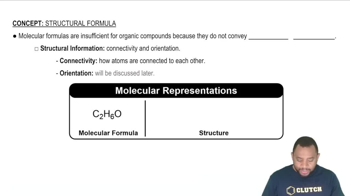
Molecular Formula

Chemical Formula

A chemical formula represents the types and numbers of atoms in a molecule. It provides essential information about the composition of a substance, such as CH3Cl for methyl chloride, indicating one carbon, three hydrogens, and one chlorine atom. Understanding chemical formulas is vital for identifying and distinguishing between different compounds.
추천 영상:
가이드 코스
02:26
Skeletal Formula

Ionic vs. Covalent Compounds

Ionic compounds are formed through the transfer of electrons between atoms, resulting in charged ions, while covalent compounds involve the sharing of electrons. For instance, the nitrate ion (NO3-) is an ionic species, whereas propane (C3H8) is a covalent molecule. Recognizing the differences between these types of compounds helps in predicting their behavior and interactions.
추천 영상:
가이드 코스
02:11
Ionic Compounds Naming