Ch.2 - Atoms, Molecules, and Ions
Brown - Chemistry: The Central Science 14th Edition
Brown14th EditionChemistry: The Central ScienceISBN: 9780134414232당신이 사용하는 게 아니라요?교과서 변경
2장, 문제 42

Locate each of the following elements in the periodic table; give its name and atomic number, and indicate whether it is a metal, metalloid, or nonmetal: (a) Hg (b) At (c) Mo (d) W (e) Sn (f) V (g) K.

검증된 단계별 안내
1
Step 1: Identify the element symbol 'Hg' and locate it on the periodic table. Determine its name, atomic number, and classification as a metal, metalloid, or nonmetal.
Step 2: Identify the element symbol 'At' and locate it on the periodic table. Determine its name, atomic number, and classification as a metal, metalloid, or nonmetal.
Step 3: Identify the element symbol 'Mo' and locate it on the periodic table. Determine its name, atomic number, and classification as a metal, metalloid, or nonmetal.
Step 4: Identify the element symbol 'W' and locate it on the periodic table. Determine its name, atomic number, and classification as a metal, metalloid, or nonmetal.
Step 5: Identify the element symbol 'Sn' and locate it on the periodic table. Determine its name, atomic number, and classification as a metal, metalloid, or nonmetal.

주요 개념

질문에 올바르게 답하기 위해 반드시 이해해야 하는 핵심 개념들은 다음과 같습니다.

Periodic Table Organization

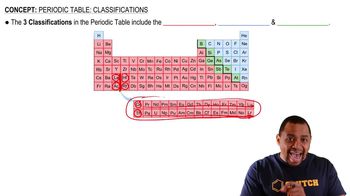
The periodic table organizes elements based on their atomic number, electron configuration, and recurring chemical properties. Elements are arranged in rows (periods) and columns (groups), with metals typically found on the left and center, nonmetals on the right, and metalloids along the dividing line. Understanding this layout is essential for identifying elements and their classifications.
추천 영상:
가이드 코스
02:40
Periodic Table Classifications

Classification of Elements

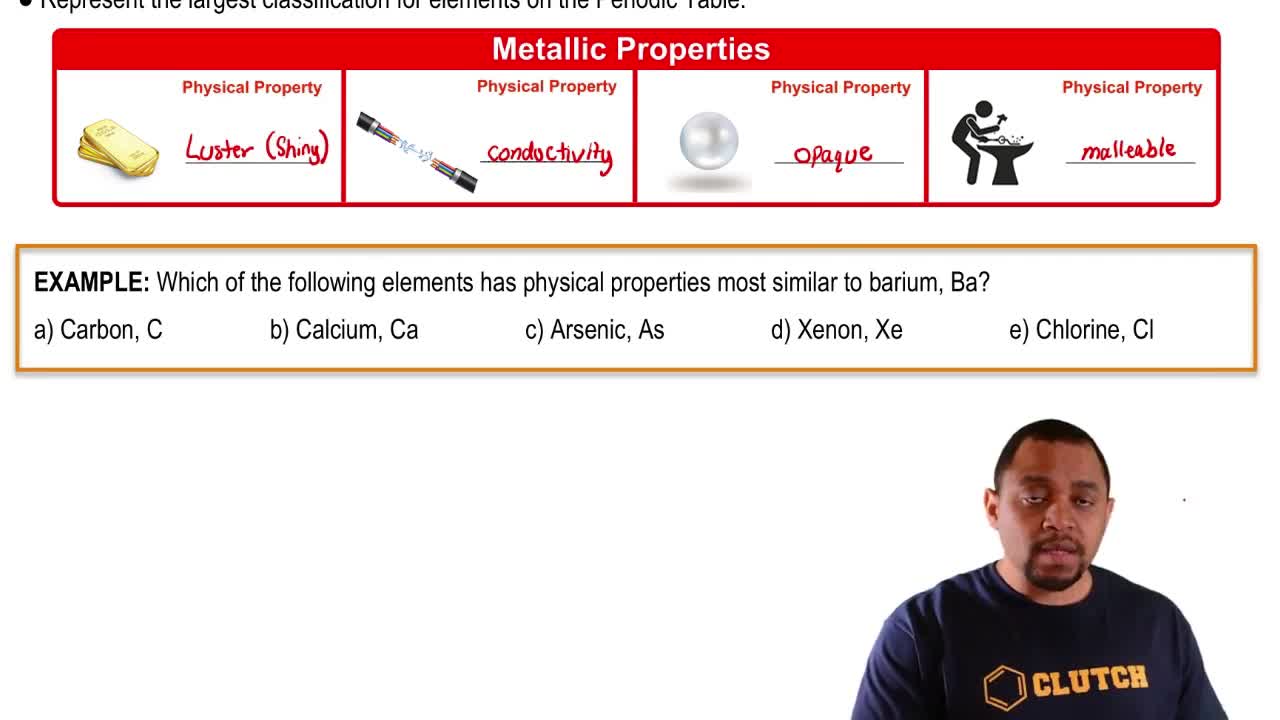
Elements are classified into three main categories: metals, metalloids, and nonmetals. Metals are generally good conductors of heat and electricity, malleable, and ductile. Nonmetals are poor conductors and can be gases or brittle solids at room temperature, while metalloids exhibit properties of both metals and nonmetals. This classification helps predict the behavior of elements in chemical reactions.
추천 영상:
가이드 코스
01:39
Element Classification Example

Atomic Number

The atomic number of an element is the number of protons in its nucleus, which determines its identity and position in the periodic table. It also indicates the number of electrons in a neutral atom, influencing the element's chemical properties. For example, knowing the atomic number allows one to quickly find the element's name and its classification as a metal, metalloid, or nonmetal.
추천 영상:
관련 실천
교과서 질문

The structural formulas of the compounds n-butane and isobutane are shown below. (b) Determine the empirical formula of each.

815
views

교과서 질문

For each of the following elements, write its chemical symbol, locate it in the periodic table, give its atomic number, and indicate whether it is a metal, metalloid, or nonmetal: (a) radon (b) tellurium (c) cadmium (d) chromium (e) barium (f) selenium (g) arsenic.

1150
views
교과서 질문

For each of the following elements, write its chemical symbol, determine the name of the group to which it belongs (Table 2.3), and indicate whether it is a metal, metalloid, or nonmetal: (a) polonium (b) strontium (c) neon (d) rubidium (e) sulfur.

603
views
교과서 질문

Massspectrometry is more often applied to molecules than to atoms. We will see in Chapter 3 that the molecular weight of a molecule is the sum of the atomic weights of the atoms in the molecule. The mass spectrum of H2 is taken under conditions that prevent decomposition into H atoms. The two naturally occurring isotopes of hydrogen are 1H (atomic mass = 1.00783 amu; abundance 99.9885%) and 2H (atomic mass = 2.01410; abundance 0.0115%). (c) Which peak will be the largest, and which the smallest?

1035
views
교과서 질문

Massspectrometry is more often applied to molecules than to atoms. We will see in Chapter 3 that the molecular weight of a molecule is the sum of the atomic weights of the atoms in the molecule. The mass spectrum of H2 is taken under conditions that prevent decomposition into H atoms. The two naturally occurring isotopes of hydrogen are 1H (atomic mass = 1.00783 amu; abundance 99.9885%) and 2H (atomic mass = 2.01410; abundance 0.0115%). (a) How many peaks will the mass spectrum have?

556
views