Ch.2 - Atoms, Molecules, and Ions
Brown - Chemistry: The Central Science 14th Edition
Brown14th EditionChemistry: The Central ScienceISBN: 9780134414232당신이 사용하는 게 아니라요?교과서 변경
2장, 문제 72j

Name the following ionic compounds: (j) Ag2Cr2O7.

검증된 단계별 안내
1
Step 1: Identify the cation and the anion in the compound. In Ag2Cr2O7, Ag is the cation and Cr2O7 is the anion.
Step 2: Name the cation first. The cation Ag is silver.
Step 3: Name the anion. The anion Cr2O7 is dichromate.
Step 4: Combine the names of the cation and anion. In this case, the name of the compound is Silver Dichromate.

비슷한 문제에 대한 검증된 영상 답변:

이 영상 해법은 위 문제에 도움이 된다고 튜터들이 추천한 것입니다.
영상 길이:
1m
도움이 되었나요?

주요 개념

질문에 올바르게 답하기 위해 반드시 이해해야 하는 핵심 개념들은 다음과 같습니다.

Ionic Compounds

Ionic compounds are formed when atoms transfer electrons, resulting in the formation of positively charged cations and negatively charged anions. These oppositely charged ions attract each other, creating a stable compound. Understanding the nature of ionic bonds is essential for naming and writing formulas for these compounds.
추천 영상:
가이드 코스
02:11
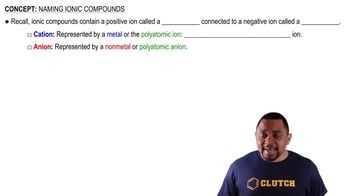
Ionic Compounds Naming

Nomenclature of Ionic Compounds

The nomenclature of ionic compounds involves specific rules for naming the cations and anions. Cations, typically metal ions, retain their elemental name, while anions often have their names modified, usually by adding an '-ide' suffix or using a specific name for polyatomic ions. Familiarity with these naming conventions is crucial for accurately identifying compounds.
추천 영상:
가이드 코스
02:11
Ionic Compounds Naming

Polyatomic Ions

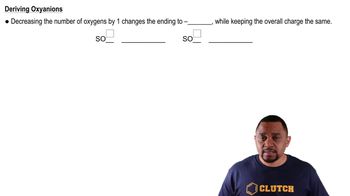
Polyatomic ions are ions composed of two or more atoms that are covalently bonded and carry a net charge. Common examples include sulfate (SO4^2-) and chromate (CrO4^2-). Recognizing polyatomic ions and their charges is vital for correctly naming compounds that contain them, such as Ag2Cr2O7, which includes the dichromate ion (Cr2O7^2-).
추천 영상:
가이드 코스
01:20
Polyatomic Ion Variations