Ch.2 - Atoms, Molecules, and Ions
Brown - Chemistry: The Central Science 14th Edition
Brown14th EditionChemistry: The Central ScienceISBN: 9780134414232당신이 사용하는 게 아니라요?교과서 변경
2장, 문제 73f

Write the chemical formulas for the following compounds: (f) iron(III)carbonate

검증된 단계별 안내
1
Identify the cation and its charge: Iron(III) indicates the iron cation with a charge of +3, written as \( \text{Fe}^{3+} \).
Identify the anion and its charge: Carbonate is a polyatomic ion with the formula \( \text{CO}_3^{2-} \).
Determine the ratio of cations to anions needed to balance the charges: To balance the charges between \( \text{Fe}^{3+} \) and \( \text{CO}_3^{2-} \), find the least common multiple of the charges, which is 6.
Calculate the number of each ion needed: You need 2 iron(III) ions (\( 2 \times +3 = +6 \)) and 3 carbonate ions (\( 3 \times -2 = -6 \)) to balance the charges.
Write the chemical formula by combining the ions in the correct ratio: The formula for iron(III) carbonate is \( \text{Fe}_2(\text{CO}_3)_3 \).

비슷한 문제에 대한 검증된 영상 답변:

이 영상 해법은 위 문제에 도움이 된다고 튜터들이 추천한 것입니다.
영상 길이:
1m

주요 개념

질문에 올바르게 답하기 위해 반드시 이해해야 하는 핵심 개념들은 다음과 같습니다.

Iron(III) Ion

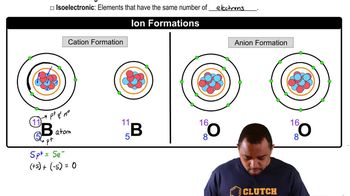
The iron(III) ion, denoted as Fe³⁺, is a cation formed when iron loses three electrons. This oxidation state is common in various iron compounds and is crucial for determining the overall charge balance in ionic compounds. Understanding the charge of the iron ion is essential for writing the correct formula for iron(III) carbonate.
추천 영상:

Carbonate Ion

The carbonate ion, represented as CO₃²⁻, is a polyatomic ion consisting of one carbon atom covalently bonded to three oxygen atoms. It carries a -2 charge, which is important for balancing the charges when combined with cations like iron(III). Recognizing the structure and charge of the carbonate ion is vital for constructing the correct chemical formula.
추천 영상:

Ionic Compound Formation

Ionic compounds are formed through the electrostatic attraction between cations and anions. The total positive charge from the cations must equal the total negative charge from the anions to achieve charge neutrality. In the case of iron(III) carbonate, one Fe³⁺ ion combines with three CO₃²⁻ ions to form the neutral compound, Fe₂(CO₃)₃.
추천 영상:
가이드 코스
02:11
Ionic Compounds Naming