Ch.2 - Atoms, Molecules, and Ions
Brown - Chemistry: The Central Science 14th Edition
Brown14th EditionChemistry: The Central ScienceISBN: 9780134414232당신이 사용하는 게 아니라요?교과서 변경
2장, 문제 76a,b,c

Provide the name or chemical formula, as appropriate, for each of the following acids: (a) hydroiodic acid (b) chloric acid (c) nitrous acid

검증된 단계별 안내
1
Identify the type of acid mentioned in the problem. In this case, it is 'hydroiodic acid'.
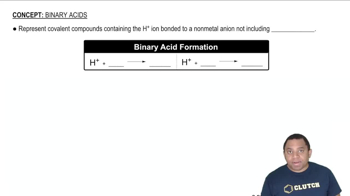
Recognize that the prefix 'hydro-' in the name indicates that this is a binary acid, which consists of hydrogen and one other non-metal element.
Determine the non-metal element in the acid from its name. For hydroiodic acid, the non-metal element is iodine.
Write the chemical symbol for hydrogen, which is 'H', and for iodine, which is 'I'.
Combine the symbols of hydrogen and iodine to form the chemical formula for hydroiodic acid, which is 'HI'.

비슷한 문제에 대한 검증된 영상 답변:

이 영상 해법은 위 문제에 도움이 된다고 튜터들이 추천한 것입니다.
영상 길이:
1m

주요 개념

질문에 올바르게 답하기 위해 반드시 이해해야 하는 핵심 개념들은 다음과 같습니다.

Acids and Their Nomenclature

Acids are substances that can donate protons (H+) in a solution. The nomenclature of acids depends on their composition; binary acids, like hydroiodic acid, are named using the prefix 'hydro-' followed by the root of the nonmetal and the suffix '-ic'. Understanding this naming convention is essential for identifying and writing the correct chemical formulas for various acids.
추천 영상:

Chemical Formula Representation

The chemical formula of a compound provides a concise way to represent its composition. For acids, the formula typically starts with hydrogen (H) followed by the anion. In the case of hydroiodic acid, the formula is HI, indicating one hydrogen atom bonded to one iodine atom. Recognizing how to derive and interpret these formulas is crucial for chemistry.
추천 영상:
가이드 코스
02:08
Molecular Formula

Properties of Hydroiodic Acid

Hydroiodic acid (HI) is a strong acid, meaning it completely dissociates in water to release H+ ions. This property is significant in understanding its behavior in chemical reactions and its applications in various fields, such as organic synthesis and analytical chemistry. Familiarity with the characteristics of strong acids helps predict their reactivity and interactions with other substances.
추천 영상:
가이드 코스
01:34
Chemical Properties Example