Ch.2 - Atoms, Molecules, and Ions
Brown - Chemistry: The Central Science 14th Edition
Brown14th EditionChemistry: The Central ScienceISBN: 9780134414232당신이 사용하는 게 아니라요?교과서 변경
2장, 문제 76f

Provide the name or chemical formula, as appropriate, for each of the following acids: (f) CH3COOH.

검증된 단계별 안내
1
Identify the molecular structure given in the problem: CH3COOH.
Recognize that the structure represents an organic acid due to the presence of the COOH group, which is characteristic of carboxylic acids.
Note that the CH3 group attached to the COOH indicates that the acid is a simple carboxylic acid with one carbon in the alkyl chain.
Recall that the common name for the acid with the formula CH3COOH is acetic acid.
Alternatively, use the systematic IUPAC nomenclature to name the compound as ethanoic acid, reflecting the two-carbon structure of the molecule.

비슷한 문제에 대한 검증된 영상 답변:

이 영상 해법은 위 문제에 도움이 된다고 튜터들이 추천한 것입니다.
영상 길이:
42s

주요 개념

질문에 올바르게 답하기 위해 반드시 이해해야 하는 핵심 개념들은 다음과 같습니다.

Acids and Their Properties

Acids are substances that can donate protons (H⁺ ions) in a solution. They typically have a sour taste and can react with bases to form salts and water. Understanding the properties of acids is essential for identifying and naming them correctly.
추천 영상:
가이드 코스
01:34
Chemical Properties Example

Functional Groups in Organic Chemistry

In organic chemistry, functional groups are specific groups of atoms within molecules that determine the chemical properties of those molecules. The carboxyl group (-COOH) is a key functional group in organic acids, influencing their acidity and reactivity.
추천 영상:
가이드 코스
01:00
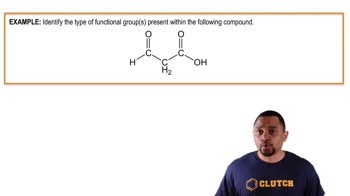
Functional Groups In Chemistry Example

Nomenclature of Organic Compounds

The nomenclature of organic compounds follows specific rules set by the International Union of Pure and Applied Chemistry (IUPAC). For acids, the naming convention often involves identifying the longest carbon chain and the functional group, leading to names like acetic acid for CH₃COOH.
추천 영상:
가이드 코스
02:26
Introduction to Organic Chemistry